
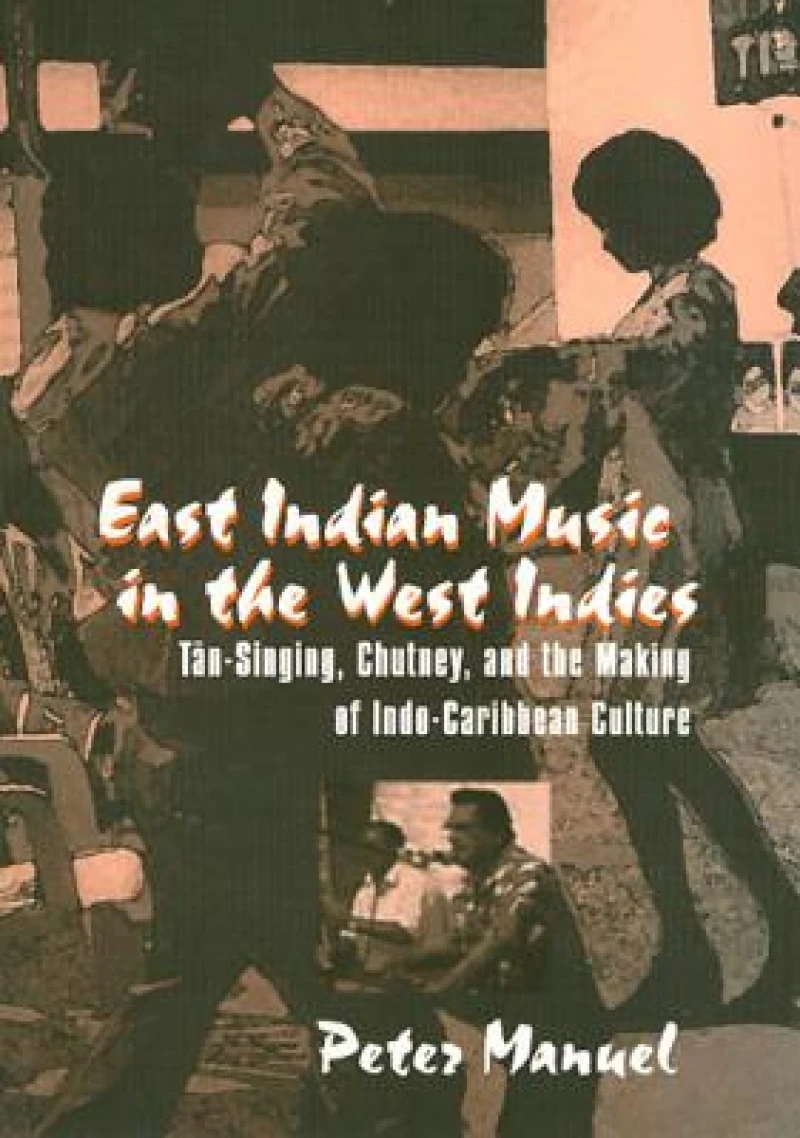
East Indian Music
by
Peter Manuel
Book Details
Format
Multiple-Item Product
Book Series
Studies in Latin America & Car
ISBN-10
1566397634
ISBN-13
9781566397636
Publisher
Temple University Press,U.S.
Imprint
Temple University Press,U.S.
Country of Manufacture
US
Country of Publication
GB
Publication Date
Jun 7th, 2000
Print length
252 Pages
Weight
502 grams
Dimensions
25.50 x 17.50 x 1.70 cms
Ksh 6,300.00
Werezi Extended Catalogue
0 in stock
Delivery Location
Delivery fee: Select location
Secure
Quality
Fast
Documents the social and cultural development of a people "without history," a people who have sometimes been dismissed as foreigners who merely perpetuate the culture of the homeland rather than becoming "truly" Caribbean. This book examines the distinctiveness of traditional Indo-Caribbean musical culture.
Trinidadian sitarist, composer, and music authority Mangal Patasar once remarked and tan-singing, \u0022You take a capsule from India, leave it here for a hundred years, and this is what you get.\u0022 Patasar was referring to what may be the most sophisticated and distinctive art form cultivated among the one and a half million East Indians whose ancestors migrated as indentured laborers from colonial India to the West Indies between 1845 and 1917. Known in Trinidad and Guyana as \u0022tan-singing\u0022 or \u0022local-classical music\u0022 and in Suriname as \u0022baithak gana\u0022 (\u0022sitting music\u0022), tan-singing has evolved in to a unique idiom, embodying the rich poetic and musical heritage brought from India as modified by a diaspora group largely cut off from its ancestral homeland. In recent decades, however, tan-singing has been declining, regarded as quaint and crude by younger generations raised on MTV, Hindi film music, and disco. At the same time, Indo-Caribbeans have been participating in their countries' economic, political, and cultural lives to a far greater extent than previously. Accompanying this participation has been a lively cultural revival, encompassing both an enhanced assertion of Indianness and a spirit of innovative syncretism. One of the most well-known products of this process is chutney, a dynamic music and dance phenomenon that is simultaneously a folk revival and a pop hybrid. In Trinidad, it has also been the vehicle for a controversial form of female empowerment and an agent of a new, more inclusive, conception of national identity. Thus, East Indian Music in the West Indies is a portrait of a diaspora community in motion. It documents the social and cultural development of a people \u0022without history,\u0022 a people who have sometimes been dismissed as foreigners who merely perpetuate the culture of the homeland rather than becoming \u0022truly\u0022 Caribbean. Professor Manuel shows how inaccurate this characterization is. On the one hand, in the form of tan-singing, it examines the distinctiveness of traditional Indo-Caribbean musical culture. On the other, in the form of chutney, it examines the new assertiveness and syncretism of Indo-Caribbean popular music. Students of Indo-Caribbean music and curious world-music fans alike will be fascinated by Professor Manuel's guided tour through the complex and exciting world of Indo-Caribbean musical culture.
Get East Indian Music by at the best price and quality guaranteed only at Werezi Africa's largest book ecommerce store. The book was published by Temple University Press,U.S. and it has pages.

