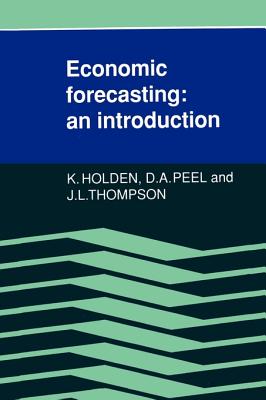
Economic Forecasting : An Introduction
Book Details
Format
Paperback / softback
ISBN-10
052135692X
ISBN-13
9780521356923
Publisher
Cambridge University Press
Imprint
Cambridge University Press
Country of Manufacture
GB
Country of Publication
GB
Publication Date
Apr 4th, 1991
Print length
224 Pages
Weight
340 grams
Dimensions
22.90 x 15.20 x 1.30 cms
Product Classification:
Economic forecastingPolitical economy
KSh 6,150.00
Currently unavailable
0 in stock
Delivery Location
Delivery fee: Select location
Secure
Quality
Fast
This book provides an introduction to the methods employed in forecasting the future state of the economy. It is the only text currently available which provides a comprehensive coverage of methods and applications in this fast-growing area.
This book provides an introduction to the methods employed in forecasting the future state of the economy. It provides a comprehensive coverage of methods and applications in this fast-growing area and is intended for use in postgraduate and upper-level undergraduate courses. Part I outlines the available techniques, particularly those used in business forecasting and econometric forecasting. The state of the art in time series modelling is reviewed and includes a discussion of Box-Jenkins models, the vector autogressive approach and cointegration. Ways of combining forecasts are also examined in detail. Part II considers the most important applications of forecasting. Applications in microeconomics include demand and sales forecasting, the use of anticipations data, leading indicators and scenario analysis. In macroeconomics the emphasis is on why errors occur in forecasting asset market prices, including implications of the efficient markets hypothesis for foreign markets, stock market prices and commodity market prices. The book ends with a discussion of the appropriateness of various techniques, recent developments in forecasting, and the links between economic forecasting and government policy.
Get Economic Forecasting by David A. Peel, John L. Thompson at the best price and quality guaranteed only at Werezi Africa's largest book ecommerce store. The book was published by Cambridge University Press and it has 224 pages.
Customers Who Bought This Also Bought
Growth Delusion
KSh 2,350.00

Conflict Inflation
KSh 8,650.00

The Economic Merry-Go-Round (RLE: Business Cycles)
KSh 8,800.00

Global Economic Prospects, June 2024
KSh 7,200.00

We Make Our Own History
KSh 5,050.00
Growth Policy in the Age of High Technology
KSh 20,600.00
Perspectives on an Economic Future
KSh 13,500.00
Tight Money Timing
KSh 12,600.00

The Growth of Public Expenditure in the United Kingdom
KSh 6,350.00

Flourishing
KSh 4,500.00

Parry''s Valuation and Investment Tables
KSh 9,850.00
Economic Forecasting
KSh 16,200.00