
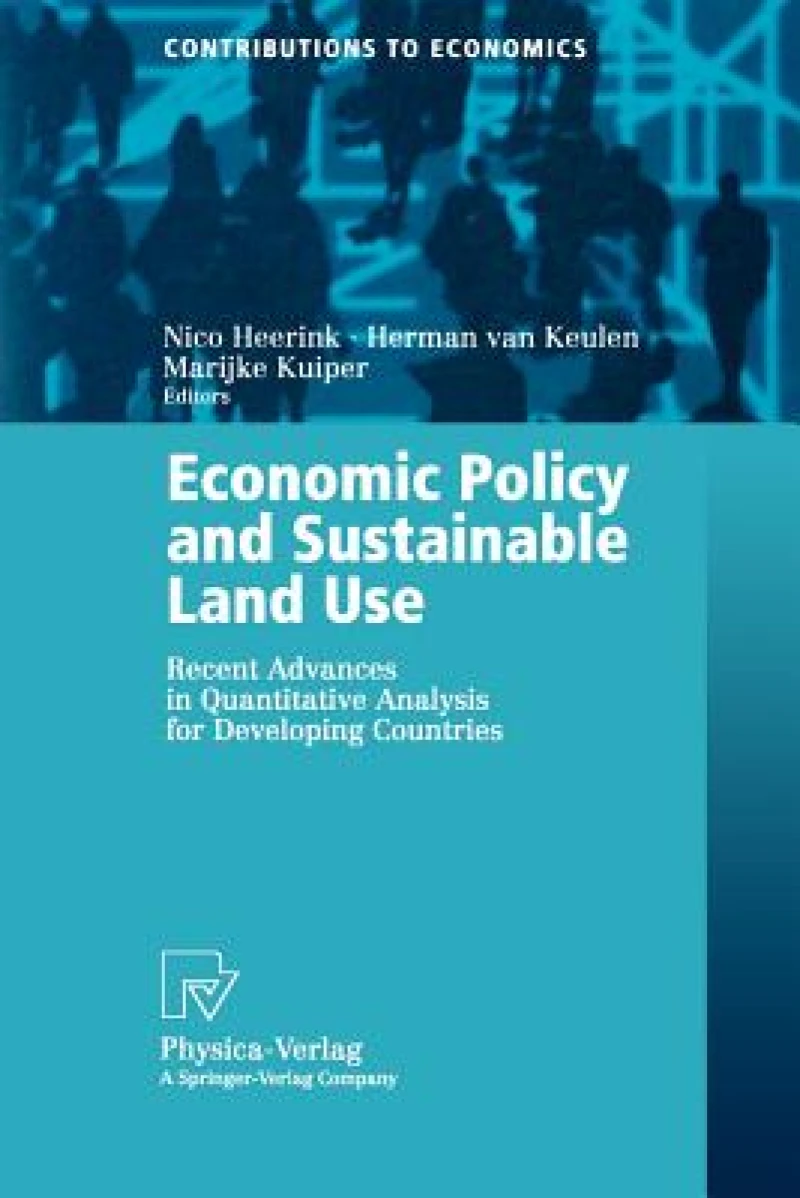
Economic Policy and Sustainable Land Use : Recent Advances in Quantitative Analysis for Developing Countries
2001 ed.
Book Details
Format
Paperback / Softback
Book Series
Contributions to Economics
ISBN-10
3790813516
ISBN-13
9783790813517
Edition
2001 ed.
Publisher
Springer-Verlag Berlin and Heidelberg GmbH & Co. KG
Imprint
Physica-Verlag GmbH & Co
Country of Manufacture
DE
Country of Publication
GB
Publication Date
Nov 27th, 2000
Print length
376 Pages
Ksh 16,200.00
Werezi Extended Catalogue
0 in stock
Delivery Location
Delivery fee: Select location
Secure
Quality
Fast
This is an overview of quantitative approaches to analyse the effects of economic policy reforms on sustainable land use in developing countries. It illustrates advances in modelling approaches at the plot, household, regional and national level.
Since the 1980s many developing countries have implemented macro-economic policy reforms to curb inflation, reduce fiscal deficits and control foreign debt. The policy instruments used, such as exchange rate adjustment, budget cuts, trade policy reforms, public expenditure reviews and privatisation, have different and sometimes opposite consequences for agricultural land use. During the same period awareness was growing that deteriorating soil quality could become a limiting factor to increase or even sustain agricultural production. As a result, food availability and even accessibility for large population groups in developing countries may be jeopardised in the near future. Recently, quantitative models have made useful contributions to understanding the impact of economic policy reforms on the sustainability of land use. They provide a consistent analytical framework to deal with complex issues such as the direct and indirect effects of economic, agricultural, environmental and population policies, the role of market imperfections in transmitting economic policy signals, and the interactions between soil quality, agricultural production and household economic decision making. Different types of models can be distinguished: bio economic models, focussing on the link between farm household decisions and the agricultural resource base, household and village models, examining the impact of the socio-economic environment on farm household decisions, and more aggregate models, analysing interactions between sectors and their implications for sustainable land use.
Get Economic Policy and Sustainable Land Use by at the best price and quality guaranteed only at Werezi Africa's largest book ecommerce store. The book was published by Springer-Verlag Berlin and Heidelberg GmbH & Co. KG and it has pages.

