
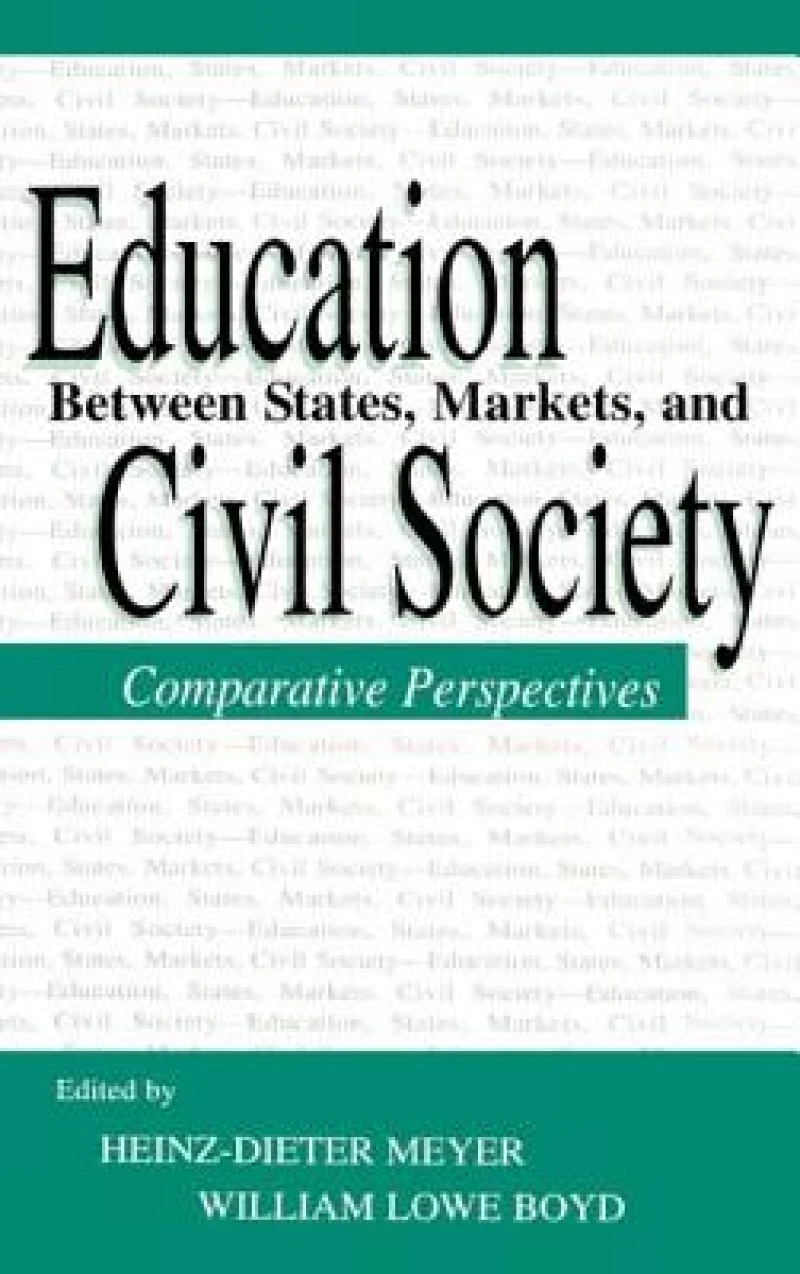
Education Between State, Markets, and Civil Society : Comparative Perspectives
Book Details
Format
Hardback or Cased Book
ISBN-10
0805831959
ISBN-13
9780805831955
Publisher
Taylor & Francis Inc
Imprint
Routledge
Country of Manufacture
GB
Country of Publication
GB
Publication Date
May 1st, 2001
Print length
258 Pages
Weight
552 grams
Dimensions
23.70 x 16.20 x 2.20 cms
Product Classification:
Organization & management of education
Ksh 27,900.00
Werezi Extended Catalogue
0 in stock
Delivery Location
Delivery fee: Select location
Secure
Quality
Fast
Scholars from the US & Europe explore the promise of "civil society" to rejeuvenate systems of public education that are frequently characterized by bureaucratic over-regulation, lack of diversity and choice, and inequality of opportunity.
*How should education be organized in pluralistic and multicultural societies?
*What are the roles in education of civil society, markets, governments, and the family?
*How can the idea of the civil society help to reorient education policy discussions that are sometimes stuck in either-or juxtapositions of "market versus government" or "individualism versus communitarianism?"
*What are some of the traditions of civil society--across countries and across history--that educators and policymakers today can revive or build on?
These questions are at the center of this book. Its goal is to understand how we can accommodate cultural, ethnic, and religious pluralism in a political and conceptual framework that is sufficiently flexible to combine choice with equity, a commitment to a shared civil and political culture with openness to exploring and affirming the distinct ethnicity, race, creed, or culture of different groups.
To address these questions, the authors take up the notion of the civil society, an idea that has experienced a popular and scholarly revival in recent years as numerous citizens, action groups, political philosophers, and social scientists make the case that only a democratic civil society can sustain a democratic state. The implications of this development for education have to date been very little explored. This book is a step toward addressing this gap.
Going beyond simple juxtapositions of "market versus government" in education reform, the book as a whole develops an integrative perspective informed by the idea of the civil society. It combines current policy issues with a look at their historical development, and evaluates U.S. educational policy in the context of a range of international cases. The authors--education scholars, sociologists, economists, historians, and philosophers-- explore from diverse disciplinary, political, and philosophical points of view, the potential of the civil society and civic associations for education. At the same time, they share the hope that a thorough reconsideration of the role of the state, the market, and the civil society will help to energize ongoing experiments with charter schools, voucher schemes, and a variety of other plans to increase educational and school autonomy.
*What are the roles in education of civil society, markets, governments, and the family?
*How can the idea of the civil society help to reorient education policy discussions that are sometimes stuck in either-or juxtapositions of "market versus government" or "individualism versus communitarianism?"
*What are some of the traditions of civil society--across countries and across history--that educators and policymakers today can revive or build on?
These questions are at the center of this book. Its goal is to understand how we can accommodate cultural, ethnic, and religious pluralism in a political and conceptual framework that is sufficiently flexible to combine choice with equity, a commitment to a shared civil and political culture with openness to exploring and affirming the distinct ethnicity, race, creed, or culture of different groups.
To address these questions, the authors take up the notion of the civil society, an idea that has experienced a popular and scholarly revival in recent years as numerous citizens, action groups, political philosophers, and social scientists make the case that only a democratic civil society can sustain a democratic state. The implications of this development for education have to date been very little explored. This book is a step toward addressing this gap.
Going beyond simple juxtapositions of "market versus government" in education reform, the book as a whole develops an integrative perspective informed by the idea of the civil society. It combines current policy issues with a look at their historical development, and evaluates U.S. educational policy in the context of a range of international cases. The authors--education scholars, sociologists, economists, historians, and philosophers-- explore from diverse disciplinary, political, and philosophical points of view, the potential of the civil society and civic associations for education. At the same time, they share the hope that a thorough reconsideration of the role of the state, the market, and the civil society will help to energize ongoing experiments with charter schools, voucher schemes, and a variety of other plans to increase educational and school autonomy.
Get Education Between State, Markets, and Civil Society by at the best price and quality guaranteed only at Werezi Africa's largest book ecommerce store. The book was published by Taylor & Francis Inc and it has pages.

