
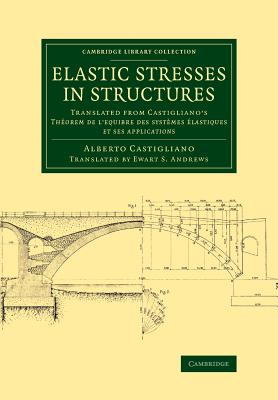
Elastic Stresses in Structures : Translated from Castigliano's Theorem de l'equibre des systemes elastiques et ses applications
Book Details
Format
Paperback / softback
Book Series
Cambridge Library Collection - Physical Sciences
ISBN-10
1108070264
ISBN-13
9781108070263
Publisher
Cambridge University Press
Imprint
Cambridge University Press
Country of Manufacture
GB
Country of Publication
GB
Publication Date
Sep 25th, 2014
Print length
400 Pages
Weight
640 grams
Dimensions
24.40 x 17.00 x 2.10 cms
Product Classification:
Structural engineering
KSh 8,350.00
Currently unavailable
0 in stock
Delivery Location
Delivery fee: Select location
Secure
Quality
Fast
The Italian mathematician Carlo Alberto Castigliano (1847–84) provided the first full proof of virtual work methods for structural analysis in his 1873 dissertation. Published as Théorie de l'équilibre des systèmes élastiques et ses applications in 1879, it is here reissued in the first English translation of 1919.
Many of the modern methods of structural analysis based on concepts of virtual work and energy were developed and popularised in Italy in the latter half of the nineteenth century. Building on the work of Luigi Menabrea, the mathematician Carlo Alberto Castigliano (1847–84) provided the first full proof of these methods in his 1873 dissertation while based in Turin. Equally important was his popularisation of the theory in his Théorie de l'équilibre des systèmes élastiques et ses applications (1879), in which he applied his theory to a wide range of important real-world cases. The work is here reissued in its 1919 English translation, by the consulting engineer and lecturer Ewart S. Andrews. Castigliano covers the basic theory of elastic stresses, introducing useful approximations; he then moves on to the analysis of real structures, including roof trusses, arches and bridges in both iron and masonry.
Get Elastic Stresses in Structures by Alberto Castigliano at the best price and quality guaranteed only at Werezi Africa's largest book ecommerce store. The book was published by Cambridge University Press and it has 400 pages.
Customers Who Bought This Also Bought

Structures
KSh 2,700.00

Design of Structural Elements
KSh 10,550.00
Recent Geotechnical Research at BOKU
KSh 27,000.00

Design of Structural Elements
KSh 26,300.00

Solid-Shell Finite Element Modeling of Functionally Graded Structures
KSh 26,300.00

Essentials of Construction Project Management
KSh 8,400.00
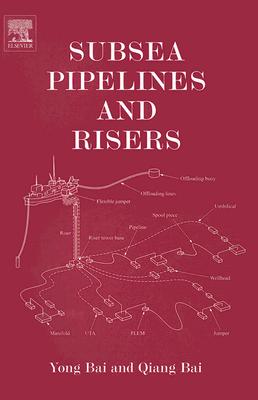
Subsea Pipelines and Risers
KSh 42,300.00
Fatigue Design of Steel and Composite Structures Eurocode 3 – Design of Steel Structures. Part 1–9 Fatigue. Eurocode 4: Design of Composite Steel and
KSh 9,000.00
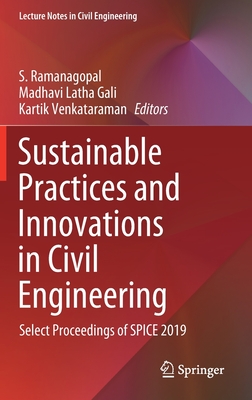
Sustainable Practices and Innovations in Civil Engineering
KSh 36,000.00

Structural Fire Engineering
KSh 20,150.00
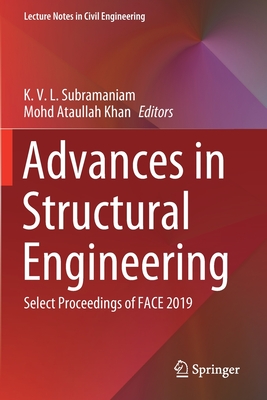
Advances in Structural Engineering
KSh 32,400.00
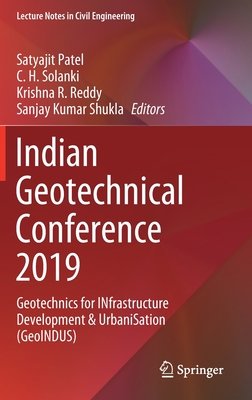
Indian Geotechnical Conference 2019
KSh 45,000.00
More in This Genre
Structures
KSh 2,700.00
Design of Structural Elements
KSh 10,550.00
Recent Geotechnical Research at BOKU
KSh 27,000.00
Design of Structural Elements
KSh 26,300.00
Solid-Shell Finite Element Modeling of Functionally Graded Structures
KSh 26,300.00
Essentials of Construction Project Management
KSh 8,400.00
