
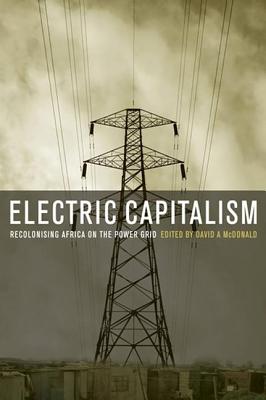
Electric Capitalism : Recolonising Africa on the Power Grid
Book Details
Format
Paperback / softback
ISBN-10
1138993425
ISBN-13
9781138993426
Publisher
Taylor & Francis Ltd
Imprint
Routledge
Country of Manufacture
GB
Country of Publication
GB
Publication Date
Dec 21st, 2015
Print length
528 Pages
Weight
980 grams
Product Classification:
Development studiesDevelopment studiesEnvironmental economicsEnvironmental economicsThe environmentAlternative and renewable energy sources and technologyAlternative & renewable energy sources & technologyEnvironmental science, engineering & technologyEnvironmental science, engineering and technology
KSh 10,400.00
Currently unavailable
0 in stock
Delivery Location
Delivery fee: Select location
Secure
Quality
Fast
Although Africa is the most under-supplied region of the world for electricity, its economies are utterly dependent on it. There are enormous inequalities in electricity access, with industry receiving abundant supplies of cheap power while more than 80 per cent of the continent''s population remain off the power grid. Africa is not unique in this respect, but levels of inequality are particularly pronounced here due to the inherent unevenness of ''electric capitalism'' on the continent. This book provides an innovative theoretical framework for understanding electricity and capitalism in Africa, followed by a series of case studies that examine different aspects of electricity supply and consumption. The chapters focus primarily on South Africa due to its dominance in the electricity market, but there are important lessons to be learned for the continent as a whole, not least because of the aggressive expansion of South African capital into other parts of Africa to develop and control electricity. Africa is experiencing a renewed scramble for its electricity resources, conjuring up images of a recolonisation of the continent along the power grid. Written by leading academics and activists, Electric Capitalism offers a cutting-edge, yet accessible, overview of one of the most important developments in Africa today - with direct implications for health, gender equity, environmental sustainability and socio-economic justice. From nuclear power through prepaid electricity meters to the massive dam projects taking place in central Africa, an understanding of electricity reforms on the continent helps shape our insights into development debates in Africa in particular and the expansion of neoliberal capitalism more generally.
Get Electric Capitalism by David A. McDonald at the best price and quality guaranteed only at Werezi Africa's largest book ecommerce store. The book was published by Taylor & Francis Ltd and it has 528 pages.
Customers Who Bought This Also Bought

How Africa Works
KSh 3,050.00

Development as Freedom
KSh 2,900.00

How Africa Works
KSh 4,500.00

Anti-Politics Machine
KSh 3,750.00

We Are Not Able to Live in the Sky
KSh 3,400.00
Apostles of Development
KSh 5,600.00

The Bottom Billion
KSh 2,500.00
Indigenous Knowledge Inquiries
KSh 6,600.00

Why Africa is poor
KSh 2,350.00

Historical Dictionary of Aid and Development Organizations
KSh 12,050.00

Contemporary Latin American Architecture
KSh 7,900.00
The Poverty of Growth
KSh 2,900.00
