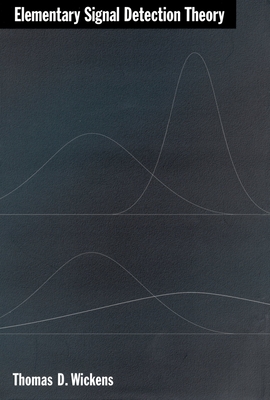
Elementary Signal Detection Theory
Book Details
Format
Hardback
ISBN-10
0195092503
ISBN-13
9780195092509
Publisher
Oxford University Press Inc
Imprint
Oxford University Press Inc
Country of Manufacture
GB
Country of Publication
GB
Publication Date
Oct 25th, 2001
Print length
288 Pages
Weight
603 grams
Dimensions
24.20 x 16.70 x 2.10 cms
Product Classification:
Cognitivism, cognitive theoryPerceptionProbability & statistics
KSh 15,250.00
Temporarily out of stock, due soon
0 in stock
Delivery Location
Delivery fee: Select location
Secure
Quality
Fast
How do humans discrimate ? And is it measurable ? In this book Thomas Wickens explains signal detection theory, which in essence, was divised to provide an explanation for the human ability to discriminate and how might we implement reliable measures to quantify this ability.
Signal detection theory, as developed in electrical engineering and based on statistical decision theory, was first applied to human sensory discrimination about 40 years ago. The theory''s intent was to explain how humans discriminate and how we might use reliable measures to quantify this ability. An interesting finding of this work is that decisions are involved even in the simplest of discrimination tasks--say, determining whether or not a sound has been heard (a yes-no decision). Detection theory has been applied to a host of varied problems (for example, measuring the accuracy of diagnostic systems, survey research, reliability of lie detection tests) and extends far beyond the detection of signals. This book is a primer on signal detection theory, useful for both undergraduates and graduate students.
Get Elementary Signal Detection Theory by Thomas D. Wickens at the best price and quality guaranteed only at Werezi Africa's largest book ecommerce store. The book was published by Oxford University Press Inc and it has 288 pages.
Customers Who Bought This Also Bought

Make It Stick – The Science of Successful Learning
KSh 5,200.00

Island Time
KSh 18,900.00

Cognitive-Behavioral Treatment of Perfectionism
KSh 7,150.00

Flow Theory Re-Envisioned
KSh 12,500.00

Phenomenology of Emotions
KSh 7,550.00

Technics and Enaction
KSh 5,400.00

Stranger and Stranger
KSh 2,900.00
Bodies and Other Objects
KSh 19,600.00

Cognitive Conrad
KSh 13,950.00

Child Development at the Intersection of Emotion and Cognition
KSh 7,400.00

Biological and Computer Vision
KSh 20,900.00

You Already Know
KSh 3,050.00