
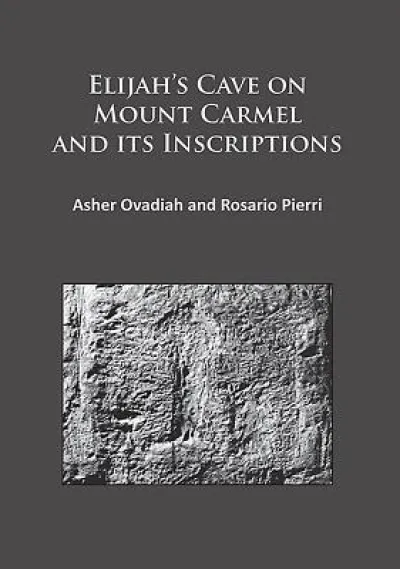
Elijah’s Cave on Mount Carmel and its Inscriptions
Book Details
Format
Paperback / Softback
ISBN-10
1784911984
ISBN-13
9781784911980
Publisher
Archaeopress
Imprint
Archaeopress Archaeology
Country of Manufacture
GB
Country of Publication
GB
Publication Date
Sep 30th, 2015
Print length
150 Pages
Weight
574 grams
Dimensions
21.20 x 29.90 x 1.30 cms
Product Classification:
Middle & Near Eastern archaeology
Ksh 6,150.00
Werezi Extended Catalogue
Delivery in 14 days
1 copies in stock
Delivery Location
Delivery fee: Select location
Delivery in 14 days
Secure
Quality
Fast
Artistic and epigraphic evidence suggest that Elijah's Cave, on the western slope of Mt. Carmel, had been used as a pagan cultic place, possibly a shrine, devoted to Ba'al Carmel (identified with Zeus/Jupiter) as well as to Pan and Eros as secondary deities.
Literary sources suggest that Mt. Carmel was a sacred site for the pagans, for the veneration and worship of Ba’al, as practiced there since the 9th century BCE through the erection of altars and temples/shrines in his honour. According to Iamblichus, the Greek philosopher Pythagoras, on his way to Egypt, visited the mountain in the second half of the 6th century BCE and sought solitude in a temple, or perhaps in a temenos. In the days of the Achaemenid king of Persia Darius I (521-486 BCE), the mountain seems to have been sacred to Zeus. Artistic and epigraphic evidence suggest that Elijah’s Cave, on the western slope of Mt. Carmel, had been used as a pagan cultic place, possibly a shrine, devoted to Ba’al Carmel (identified with Zeus/Jupiter) as well as to Pan and Eros as secondary deities. The visual representation of the cult statue (idol) of Ba’al Carmel, a libation vessel (kylix?) and the presumed figure of the priest or, alternatively, the altar within the aedicula, strengthen the assumption that the Cave was used in the Roman period, and perhaps even earlier. In addition, one of the Greek inscriptions, dated to the Roman period, indicates the sacred nature of the Cave and the prohibition of its profanation. When Elijah’s Cave ceased to be used for pagan worship it continued to be regarded as a holy site and was dedicated to Prophet Elijah, presumably in the Early Byzantine period. Following the tradition linking Elijah (so-called el-Khader) with Mt. Carmel, it became sacred to the Prophet and was used by supplicants (Jews, Christians, Muslims and Druze) to Elijah for aid, healing and salvation, a tradition that still persists to this day. There are no literary or historical sources which are recording the existence of Elijah’s Cave on Mt. Carmel prior to the 12th century. The earliest written testimony is that of the laconic description of the Russian Abbot Daniel, who made a pilgrimage to the Holy Land in 1106-1107, followed by Rabbi Benjamin of Tudela, who visited the Land of Israel in 1165. Any earlier written material must have been lost over time, since it is unlikely that the Cave and its surroundings were entirely ignored before the 12th century.
Get Elijah’s Cave on Mount Carmel and its Inscriptions by at the best price and quality guaranteed only at Werezi Africa's largest book ecommerce store. The book was published by Archaeopress and it has pages.

