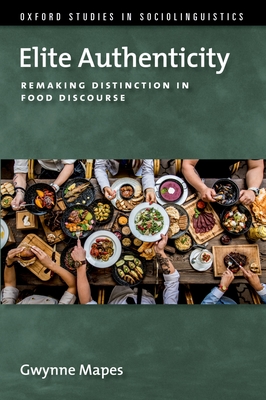
Elite Authenticity : Remaking Distinction in Food Discourse
by
Gwynne Mapes
Book Details
Format
Hardback
Book Series
Oxford Studies in Sociolinguistics
ISBN-10
0197533442
ISBN-13
9780197533444
Publisher
Oxford University Press Inc
Imprint
Oxford University Press Inc
Country of Manufacture
US
Country of Publication
GB
Publication Date
Oct 7th, 2021
Print length
220 Pages
Weight
467 grams
Dimensions
16.30 x 23.80 x 1.80 cms
Product Classification:
Food & society
KSh 20,700.00
Temporarily out of stock, due soon
0 in stock
Delivery Location
Delivery fee: Select location
Secure
Quality
Fast
This is a book about how people talk and write about food - in the New York Times, on social media, in restaurants, and around the dinner table. Using multimodal critical discourse analysis, Mapes focuses in particular on how "authenticity" proliferates in these various examples of "elite food discourse," and how it is used by stakeholders to simultaneously claim and deny social prestige. By emphasizing things like simplicity, historicity, and locality/sustainability (among others), people downplay their eliteness on the grounds of "good taste" and responsible consumerism. Ultimately, this work is a critique of that ways in which contemporary food practices (re)inforce status competition and class hierarchy.
Food plays a central role in the production of culture and is likewise a powerful resource for the representation and organization of social order. Status is asserted or contested through both the materiality of food (its substance, its raw economics, and its manufacture or preparation) and through its discursivity (its marketing, staging, and the way it is depicted and discussed). This intersection of materiality and discursivity makes food an ideal site for examining the place of language in contemporary class formations, and for engaging cutting-edge debates in sociolinguistics on language materiality.In Elite Authenticity, Gwynne Mapes integrates theories of mediatization, materiality, and authenticity in order to explore the discursive production of elite status and class inequality in food discourse. Relying on a range of methodological approaches, Mapes examines restaurant reviews and articles published in the New York Times food section; a collection of Instagram posts from @nytfood; ethnographically-informed fieldwork in four renowned Brooklyn, NY, restaurants; and a recorded dinner conversation with six food-enthusiasts. Across these varied genres of data, she demonstrates how a discourse of "elite authenticity" represents a particular surfacing of rhetorical maneuvers in which distinction is orchestrated, avowed/disavowed, and circulated.Elite Authenticity takes a multimodal critical discourse analysis approach, drawing on theories from linguistics, food and cultural studies, anthropology, sociology, and philosophy. Its presentation and analysis of aural, visual, spatial, material, and embodied discourse will be of interest to scholars and students of communication studies, critical discourse studies, sociolinguistics, linguistic anthropology, and cultural geography.
Get Elite Authenticity by Gwynne Mapes at the best price and quality guaranteed only at Werezi Africa's largest book ecommerce store. The book was published by Oxford University Press Inc and it has 220 pages.
Customers Who Bought This Also Bought
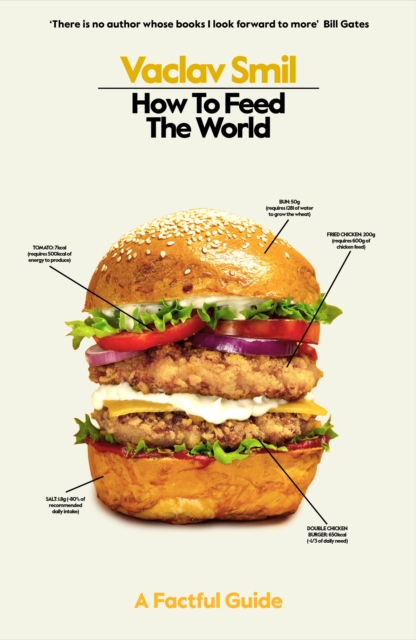
How to Feed the World
KSh 3,950.00

Africa Is Not A Country
KSh 2,350.00
How to Feed the World
KSh 8,100.00
A Bite-Sized History of Italy
KSh 3,600.00
We Are Eating the Earth
KSh 3,600.00

Diet Myth
KSh 2,000.00

Cheffe
KSh 2,000.00
Omnivore''s Dilemma
KSh 2,700.00
Cooked
KSh 2,000.00

This Is Your Mind On Plants
KSh 2,350.00

Food Rules
KSh 1,450.00

The Forager''s Calendar
KSh 2,900.00