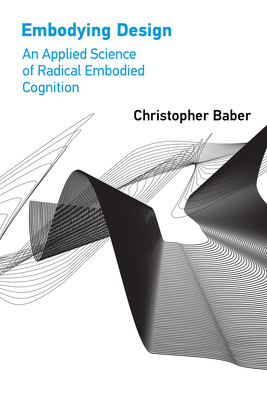
Embodying Design : An Applied Science of Radical Embodied Cognition
Book Details
Format
Paperback / softback
ISBN-10
0262543788
ISBN-13
9780262543781
Publisher
MIT Press Ltd
Imprint
MIT Press
Country of Manufacture
GB
Country of Publication
GB
Publication Date
Mar 22nd, 2022
Print length
256 Pages
Weight
372 grams
Dimensions
15.30 x 22.90 x 2.10 cms
Product Classification:
Digital and Information technology: general topicsInformation technology: general issues
KSh 6,850.00
Werezi Extended Catalogue
Delivery in 4 days
1 copies in stock
Delivery Location
Delivery fee: Select location
Delivery in 4 days
Secure
Quality
Fast
Rethinking design through the lens of embodied cognition provides a novel way of understanding human interaction with technology.
In this book, Christopher Baber uses embodied cognition as a lens through which to view both how designers engage in creative practices and how people use designed artifacts. This view of cognition as enactive, embedded, situated, or distributed, without recourse to internal representations, provides a theoretical grounding that makes possible a richer account of human interaction with technology. This understanding of everyday interactions with things in the world reveals opportunities for design to intervene. Moreover, Baber argues, design is an embodied activity in which the continual engagement between designers and their materials is at the heart of design practice.
Baber proposes that design and creativity should be considered in dynamic, rather than discrete, terms and explores “task ecologies”—the concept of environment as it relates to embodied cognition. He uses a theory of affordance as an essential premise for design practice, arguing that affordances are neither form nor function but arise from the dynamics within the human-artifact-environment system. Baber explores agency and intent of smart devices and implications of tangible user interfaces and activity recognition for human-computer interaction. He proposes a systems view of human-artifact-environment interactions—to focus on any one component or pairing misses the subtleties of these interactions. The boundaries between components remain, but the borders that allow exchange of information and action are permeable, which gives rise to synergies and interactions.
In this book, Christopher Baber uses embodied cognition as a lens through which to view both how designers engage in creative practices and how people use designed artifacts. This view of cognition as enactive, embedded, situated, or distributed, without recourse to internal representations, provides a theoretical grounding that makes possible a richer account of human interaction with technology. This understanding of everyday interactions with things in the world reveals opportunities for design to intervene. Moreover, Baber argues, design is an embodied activity in which the continual engagement between designers and their materials is at the heart of design practice.
Baber proposes that design and creativity should be considered in dynamic, rather than discrete, terms and explores “task ecologies”—the concept of environment as it relates to embodied cognition. He uses a theory of affordance as an essential premise for design practice, arguing that affordances are neither form nor function but arise from the dynamics within the human-artifact-environment system. Baber explores agency and intent of smart devices and implications of tangible user interfaces and activity recognition for human-computer interaction. He proposes a systems view of human-artifact-environment interactions—to focus on any one component or pairing misses the subtleties of these interactions. The boundaries between components remain, but the borders that allow exchange of information and action are permeable, which gives rise to synergies and interactions.
Get Embodying Design by Christopher Baber at the best price and quality guaranteed only at Werezi Africa's largest book ecommerce store. The book was published by MIT Press Ltd and it has 256 pages.
Customers Who Bought This Also Bought

How To Do Nothing
KSh 2,700.00

Elon Musk
KSh 2,350.00

God AI
KSh 2,350.00

Coding Democracy
KSh 3,050.00

Redesigning AI
KSh 3,250.00

Intelligent Systems
KSh 30,950.00

Machine Learning with Python
KSh 14,750.00

Computer Vision and SLDV for Structural Dynamics, 2026
KSh 19,800.00

Octonion Sparse-Based Image Processing
KSh 26,200.00

AI in Modern Ophthalmology
KSh 18,700.00
![Band 1-3 [Set Grundlagen der Informatik, Vol 1-3]](https://book-images.us-southeast-1.linodeobjects.com/images/9783112246054.jpg)
Band 1-3 [Set Grundlagen der Informatik, Vol 1-3]
KSh 22,950.00

AI in Modern Ophthalmology
KSh 9,900.00