
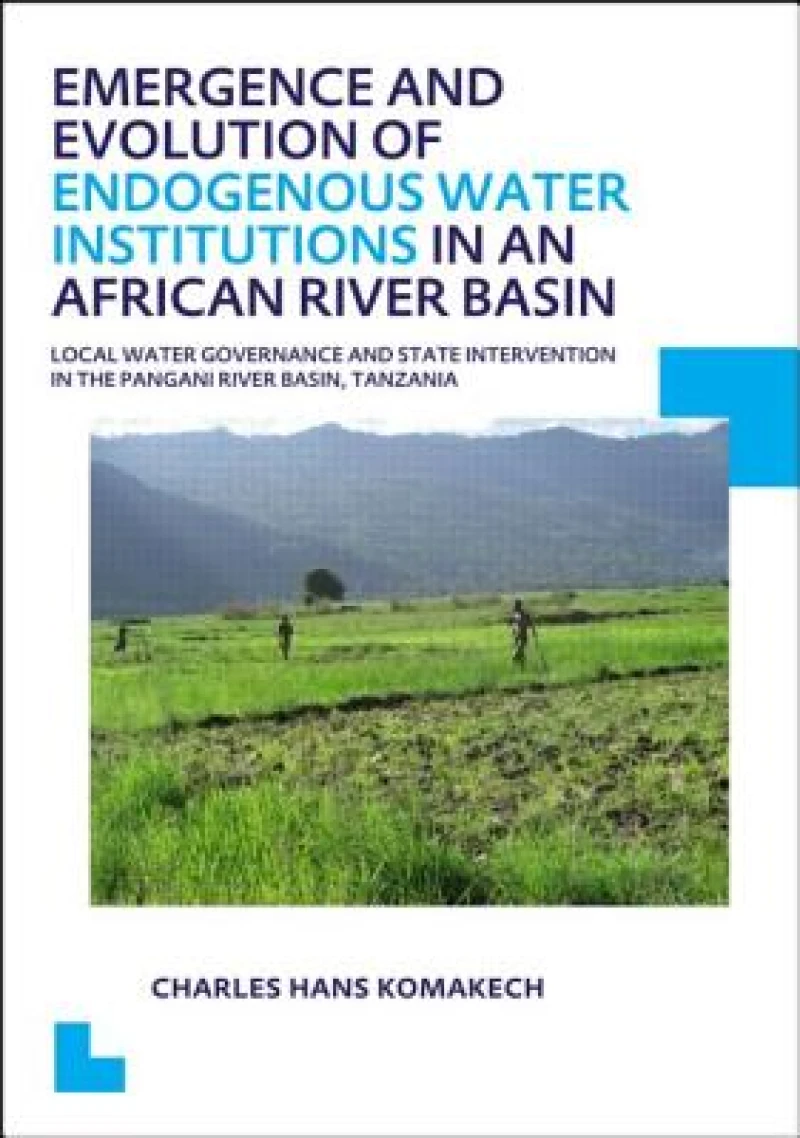
Emergence and Evolution of Endogenous Water Institutions in an African River Basin : Local Water Governance and State Intervention in the Pangani River Basin, Tanzania, UNESCO-IHE PhD Thesis
Book Details
Delivery Location
Delivery fee: Select location
Water management challenges in many basins of Sub-Saharan Africa are increasing due to rapid urbanisation, poverty and food insecurity, energy demands, and climate change. These challenges put additional demands on existing water institutions, and their capacity to reconcile competing claims. In addition to supply augmentation measures, solving water competition and conflict requires crafting new governance arrangements that can ensure equitable and sustainable use of the limited water resources.
This book discusses how instead of harmony, state intervention in the water sector appears to generate dissonance at the interface with locally evolved water institutions. The book describes and analyses how local level innovation in institutional arrangements for water sharing often emerged around the creation of hydraulic property and/or is negotiated to secure more water flow for downstream users. Unlike most research on collective action in which water asymmetry, inequality and heterogeneity are seen as risks to collective action, the book discusses how they instead dynamically interact and give rise to interdependencies between water users which facilitate coordination and collective action.
The book describes in detail cooperative arrangements as well as conflicts between large- and small-scale irrigation farmers, as well as between irrigation farmers and cities in an African context.
The book makes a novel contribution to existing theories and concepts related to catchment water management. It expands the typology of basin actors’ responses by explicitly introducing a meso layer which depicts the interface where state-led and local-level initiatives and responses are played out. The book also provides conceptual clarity on the dynamics between water asymmetry, inequality in access to land, and heterogeneity sustaining collective action over common pool resources. It further shows that not all the eight institutional design principles proposed by Ostrom (1993) are necessary for a water institution to be effective and to endure over time.
Get Emergence and Evolution of Endogenous Water Institutions in an African River Basin by at the best price and quality guaranteed only at Werezi Africa's largest book ecommerce store. The book was published by Taylor & Francis Ltd and it has pages.

