
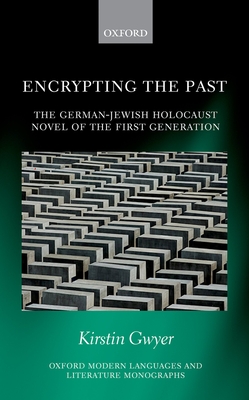
Encrypting the Past : The German-Jewish Holocaust novel of the first generation
Book Details
Format
Hardback
ISBN-10
0198709935
ISBN-13
9780198709930
Publisher
Oxford University Press
Imprint
Oxford University Press
Country of Manufacture
GB
Country of Publication
GB
Publication Date
Sep 11th, 2014
Print length
256 Pages
Weight
440 grams
Dimensions
14.50 x 21.90 x 2.10 cms
KSh 27,950.00
Currently unavailable
0 in stock
Delivery Location
Delivery fee: Select location
Secure
Quality
Fast
Encrypting the Past puts forward the literary category of the first-generation German-Jewish Holocaust novel, showing that Holocaust literature was being written decades before postwar authors such as Sebald were credited with having found new ways of reflecting the unspeakable.
Encrypting the Past puts forward the interpretative category of the first-generation German-Jewish Holocaust novel and examines its representational strategies. With reference to works by H.G. Adler, Jenny Aloni, Elisabeth Augustin, Erich Fried, and Wolfgang Hildesheimer, and a concluding section on W.G. Sebald, it shows how Holocaust literature was being written decades before postwar authors such as Sebald were credited with having found new ways of reflecting the unspeakable. It demonstrates that, before the theoretical debate over the fundamental representability of the Holocaust was even fully under way, first-generation authors were already translating un-narratable trauma into a literary strategy of un-narrating: a strategy of encrypting the Holocaust into the form and structure of their texts.The implications of treating these writers as a set, and their body of work as a hitherto unacknowledged category of Holocaust fiction, go well beyond drawing attention to a number of important but critically neglected authors. This study frames the analysis of first-generation narrative strategies in the broader debate on the ethics and aesthetics of Holocaust writing. In revealing how certain kinds of testimony have been privileged above others in international Holocaust studies, it raises questions of a more general nature concerning canon formation and our theoretical responses to the Holocaust. In considering foremost among these responses the theory of deconstruction and trauma theory, it finally invites a re-examination of the relationship between the (post-)modern and trauma.
Get Encrypting the Past by Kirstin Gwyer at the best price and quality guaranteed only at Werezi Africa's largest book ecommerce store. The book was published by Oxford University Press and it has 256 pages.
Customers Who Bought This Also Bought

Dreams in a Time of War
KSh 3,050.00
Modern Classics Penguin Essays of George Orwell
KSh 2,700.00

On Writing
KSh 2,000.00

To the Lighthouse
KSh 1,450.00

On Morrison
KSh 4,500.00

Africa''s Tarnished Name
KSh 700.00
C. S. Lewis
KSh 1,800.00

Life in Letters
KSh 5,400.00

By Grand Central Station I
KSh 1,800.00

Wide Sargasso Sea
KSh 1,800.00

Mom and Me and Mom
KSh 2,000.00

Jorge Luis Borges
KSh 1,800.00
