
Book Details
Format
Hardback or Cased Book
Book Series
Solid Mechanics and Its Applications
ISBN-10
3319984691
ISBN-13
9783319984698
Edition
2019 ed.
Publisher
Springer International Publishing AG
Imprint
Springer International Publishing AG
Country of Manufacture
CH
Country of Publication
GB
Publication Date
Jan 24th, 2019
Print length
707 Pages
Weight
1,238 grams
Dimensions
16.50 x 24.30 x 4.30 cms
Product Classification:
Statistical physicsMaterials scienceDynamics & vibration
Ksh 36,000.00
Werezi Extended Catalogue
0 in stock
Delivery Location
Delivery fee: Select location
Secure
Quality
Fast
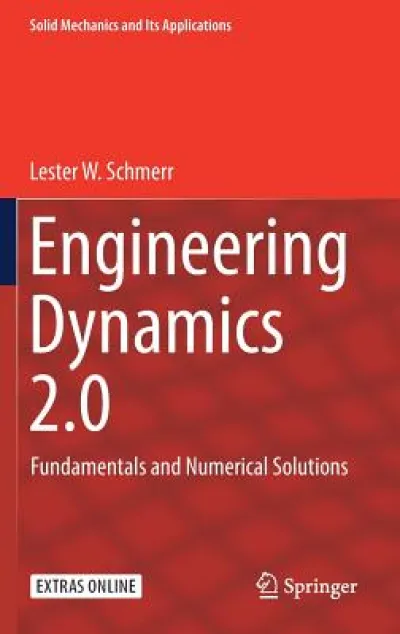
This book presents a new approach to learning the dynamics of particles and rigid bodies at an intermediate to advanced level. There are three distinguishing features of this approach. First, the primary emphasis is to obtain the equations of motion of dynamical systems and to solve them numerically. As a consequence, most of the analytical exercises and homework found in traditional dynamics texts written at this level are replaced by MATLAB®-based simulations. Second, extensive use is made of matrices. Matrices are essential to define the important role that constraints have on the behavior of dynamical systems. Matrices are also key elements in many of the software tools that engineers use to solve more complex and practical dynamics problems, such as in the multi-body codes used for analyzing mechanical, aerospace, and biomechanics systems. The third and feature is the use of a combination of Newton-Euler and Lagrangian (analytical mechanics) treatments for solving dynamics problems. Rather than discussing these two treatments separately, Engineering Dynamics 2.0 uses a geometrical approach that ties these two treatments together, leading to a more transparent description of difficult concepts such as "virtual" displacements.
Some important highlights of the book include:
- Extensive discussion of the role of constraints in formulating and solving dynamics problems.
- Implementation of a highly unified approach to dynamics in a simple context suitable for a second-level course.
- Descriptions of non-linear phenomena such as parametric resonances and chaotic behavior.
- A treatment of both dynamic and static stability.
- Overviews of the numerical methods (ordinary differential equation solvers, Newton-Raphson method) needed to solve dynamics problems.
- An introduction to the dynamics of deformable bodies and the use of finite difference and finite element methods.
Engineering Dynamics 2.0 provides a unique, modern treatment of dynamics problems that is directly useful in advanced engineering applications. It is a valuable resource for undergraduate and graduate students and for practicing engineers.
Get Engineering Dynamics 2.0 by at the best price and quality guaranteed only at Werezi Africa's largest book ecommerce store. The book was published by Springer International Publishing AG and it has pages.

