
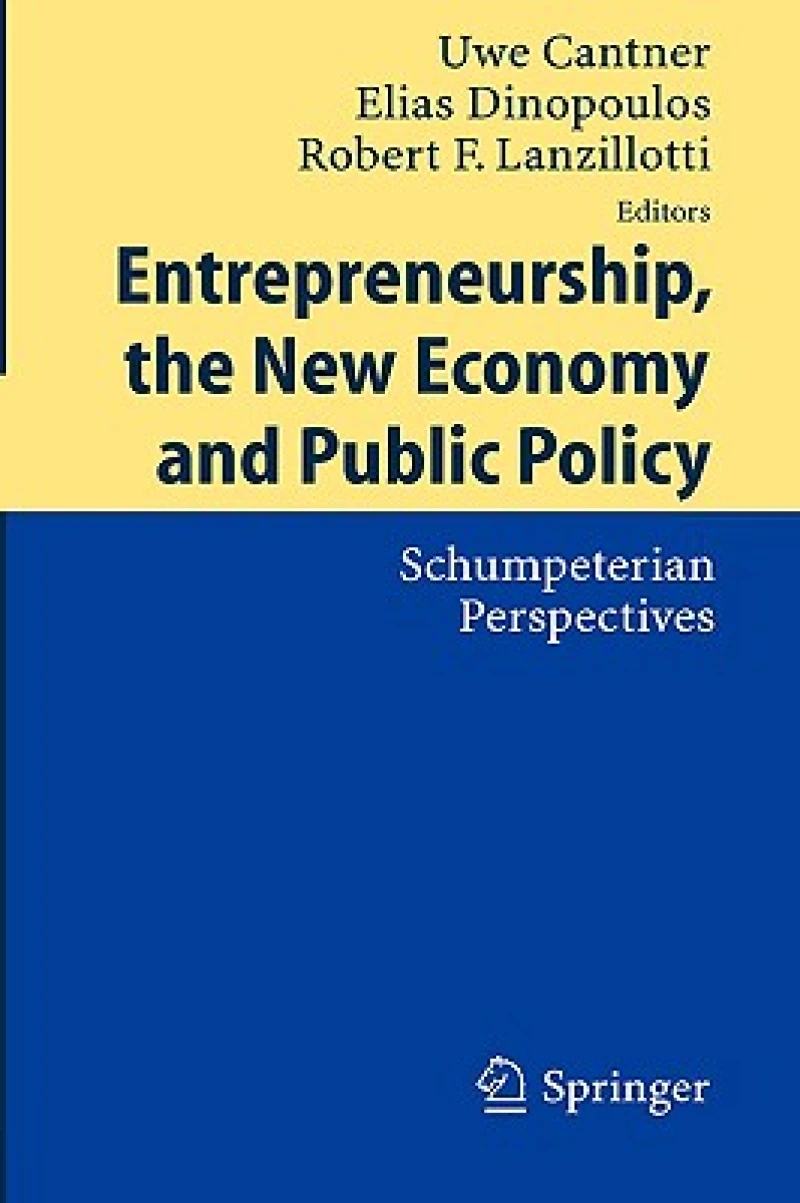
Entrepreneurship, the New Economy and Public Policy : Schumpeterian Perspectives
Book Details
Format
Hardback or Cased Book
ISBN-10
3540226133
ISBN-13
9783540226130
Publisher
Springer-Verlag Berlin and Heidelberg GmbH & Co. KG
Imprint
Springer-Verlag Berlin and Heidelberg GmbH & Co. K
Country of Manufacture
DE
Country of Publication
GB
Publication Date
Nov 23rd, 2004
Print length
346 Pages
Product Classification:
Industry & industrial studiesIndustry and industrial studies
Ksh 23,400.00
Werezi Extended Catalogue
0 in stock
Delivery Location
Delivery fee: Select location
Secure
Quality
Fast
Silicon Valley is the most salient example of high-tech industrial clusters. A high-tech industrial cluster such as Silicon Valley is characterized by c- centratedentrepreneurship. Weproposeanagent-basedcomputationalmodeltoshowhow high-tech industrial clusters could emerge in a landscape in which no ?rms existed originally.
Silicon Valley is the most salient example of high-tech industrial clusters. Public policymakersthroughouttheworldwouldliketolearnthesecretsofSiliconValley in order to build their own high-tech economies. The existing literature on ind- trial clusters, which traces back to Marshall (1920), focuses on the way in which ?rms bene?t from locating in a cluster; it suggests that once a cluster comes into existence, it tends to reinforce itself by attracting more ?rms. However, a more important question is how to reach this critical mass in the ?rst place. In contrast to the literature, evidence suggests that entrepreneurs rarely move when they est- lish high-tech start-ups (Cooper and Folta, 2000). This contradicts the notion that location choice analyses lead entrepreneurs to a high-tech cluster. A high-tech industrial cluster such as Silicon Valley is characterized by c- centratedentrepreneurship. FollowingSchumpeter,weemphasizethefactthat"the appearance of one or a few entrepreneurs facilitates the appearance of others" (Schumpeter,1934). Weproposeanagent-basedcomputationalmodeltoshowhow high-tech industrial clusters could emerge in a landscape in which no ?rms existed originally. The model is essentially a spatial version of the Nelson-Winter model: Boundedly rational agents are scattered over an explicitly de?ned landscape. Each agent is endowed with some technology, which determines his ?rm''s productivity (if he has one). During each period of time, an agent with no ?rm would make a decision as to whether he wants to start one. This decision is mostly affected by the behavior of his social contacts, who are all his neighbors.
Get Entrepreneurship, the New Economy and Public Policy by at the best price and quality guaranteed only at Werezi Africa's largest book ecommerce store. The book was published by Springer-Verlag Berlin and Heidelberg GmbH & Co. KG and it has pages.

