
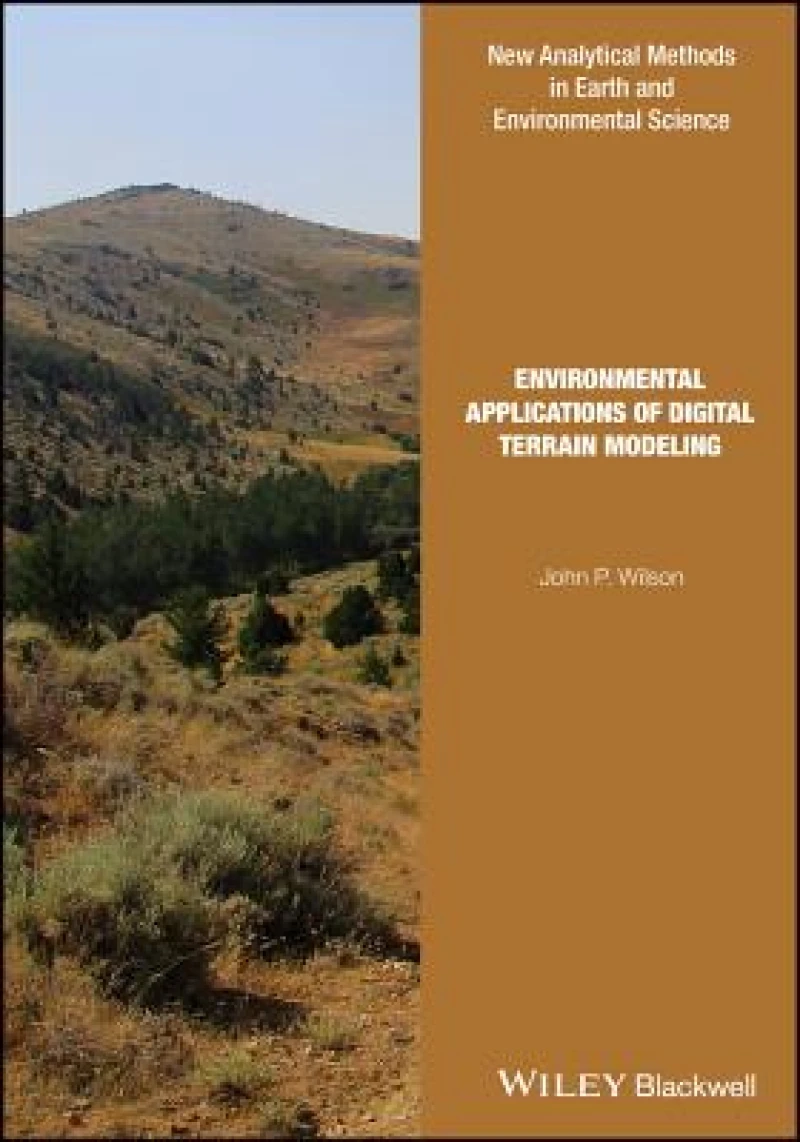
Environmental Applications of Digital Terrain Modeling
Book Details
Format
Hardback or Cased Book
ISBN-10
1118936213
ISBN-13
9781118936214
Publisher
John Wiley and Sons Ltd
Imprint
Wiley-Blackwell
Country of Manufacture
SG
Country of Publication
GB
Publication Date
Apr 18th, 2018
Print length
368 Pages
Weight
932 grams
Dimensions
26.60 x 26.20 x 2.10 cms
Product Classification:
Physical geography & topographyEnvironmental monitoring
Ksh 21,250.00
Werezi Extended Catalogue
0 in stock
Delivery Location
Delivery fee: Select location
Secure
Quality
Fast
A digital elevation model (DEM) is a digital representation of ground surface topography or terrain. It is also widely known as a digital terrain model (DTM). A DEM can be represented as a raster (a grid of squares) or as a vector based triangular irregular network (TIN). DEMs are commonly built using remote sensing techniques, but they may also be built from land surveying. DEMs are used often in geographic information systems, and are the most common basis for digitally-produced relief maps. The terrain surface can be described as compromising of two different elements; random and systematic. The random (stochastic) elements are the continuous surfaces with continuously varying relief. It would take an endless number of points to describe exactly the random terrain shapes, but these can be described in practice with a network of point. It is usual to use a network that creates sloping triangles or regular quadrants. This book examines how the methods and data sources used to generate DEMs and calculate land surface parameters have changed over the past 25 years. The primary goal is to describe the state-of-the-art for a typical digital terrain modeling workflow that starts with data capture, continues with data preprocessing and DEM generation, and concludes with the calculation of one or more primary and secondary land surface parameters. Taken as a whole, this book covers the basic theory behind the methods, the instrumentation, analysis and interpretation that are embedded in the modern digital terrain modeling workflow, the strengths and weaknesses of the various methods that the terrain analyst must choose among, typical applications of the results emanating from these terrain modeling workflows, and future directions. This book is intended for researchers and practitioners who wish to use DEMs, land surface parameters, land surface objects and landforms in environmental projects. The book will also be valuable as a reference text for environmental scientists who are specialists in related fields and wish to integrate these kinds of digital terrain workflows and outputs into their own specialized work environments.
Get Environmental Applications of Digital Terrain Modeling by at the best price and quality guaranteed only at Werezi Africa's largest book ecommerce store. The book was published by John Wiley and Sons Ltd and it has pages.

