
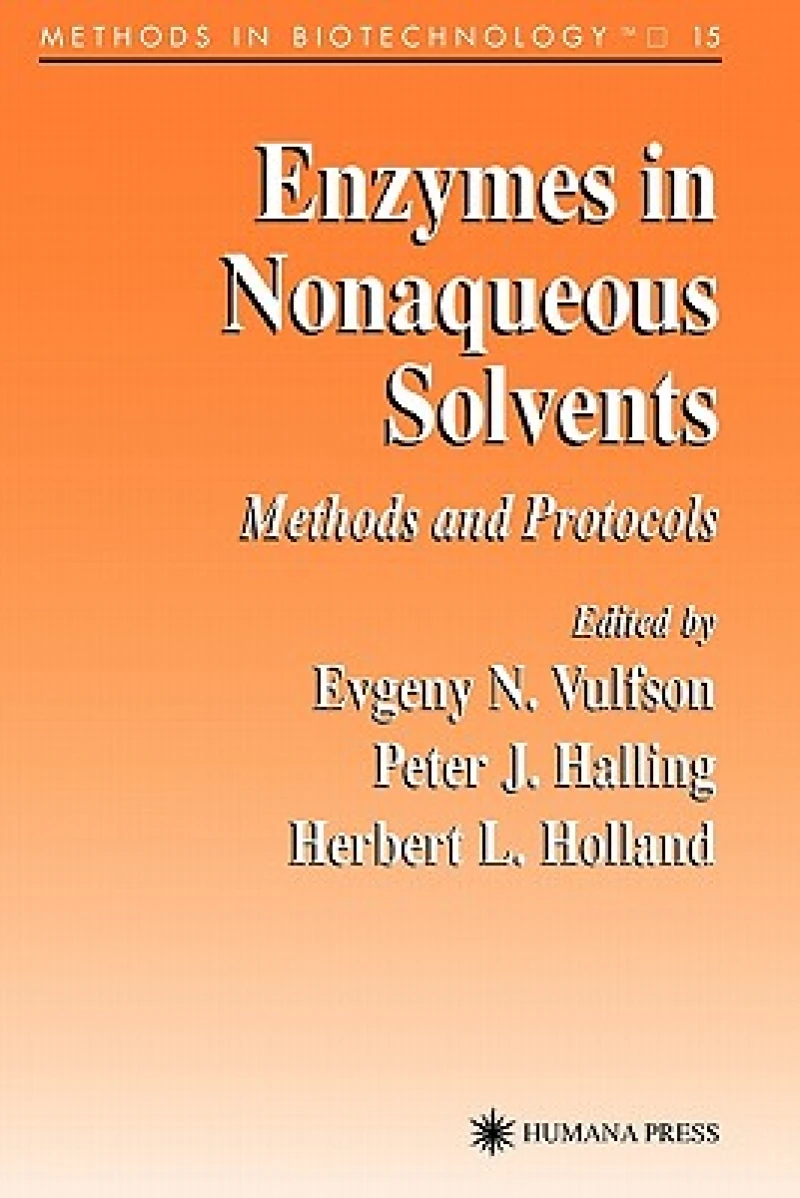
Enzymes in Nonaqueous Solvents : Methods and Protocols
1st ed. Softcover of orig. ed. 2001
Book Details
Format
Paperback / Softback
Book Series
Methods in Biotechnology
ISBN-10
1617372560
ISBN-13
9781617372568
Edition
1st ed. Softcover of orig. ed. 2001
Publisher
Humana Press Inc.
Imprint
Humana Press Inc.
Country of Manufacture
GB
Country of Publication
GB
Publication Date
Nov 19th, 2010
Print length
679 Pages
Weight
1,090 grams
Dimensions
23.00 x 15.60 x 4.30 cms
Product Classification:
Biotechnology
Ksh 23,400.00
Werezi Extended Catalogue
0 in stock
Delivery Location
Delivery fee: Select location
Secure
Quality
Fast
Another great attraction of using organic solvents rather than water as a reaction solvent is the ability to perform synthetic transformations with re- tively inexpensive hydrolytic enzymes.
Enzymatic catalysis has gained considerable attention in recent years as an efficient tool in the preparation of natural products, pharmaceuticals, fine chemicals, and food ingredients. The high selectivity and mild reaction con- tions associated with enzymatic transformations have made this approach an attractive alternative in the synthesis of complex bioactive compounds, which are often difficult to obtain by standard chemical routes. However, the maj- ity of organic compounds are not very soluble in water, which was traditi- ally perceived as the only suitable reaction medium for the application of biocatalysts. The realization that most enzymes can function perfectly well under nearly anhydrous conditions and, in addition, display a number of useful properties, e. g. , highly enhanced stability and different selectivity, has d- matically widened the scope of their application to the organic synthesis. Another great attraction of using organic solvents rather than water as a reaction solvent is the ability to perform synthetic transformations with re- tively inexpensive hydrolytic enzymes. It is worth reminding the reader that in vivo, the synthetic and hydrolytic pathways are catalyzed by different enzymes. However, elimination of water from the reaction mixture enables the "reversal" of hydrolytic enzymes and thus avoids the use of the expensive cofactors or activated substrates that are required for their synthetic count- parts.
Get Enzymes in Nonaqueous Solvents by at the best price and quality guaranteed only at Werezi Africa's largest book ecommerce store. The book was published by Humana Press Inc. and it has pages.

