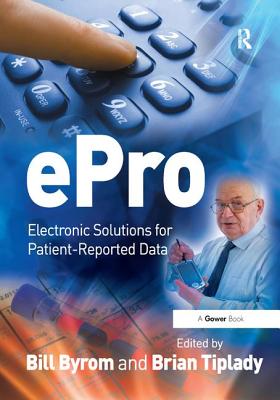
ePro : Electronic Solutions for Patient-Reported Data
Book Details
Format
Paperback / softback
ISBN-10
1032837918
ISBN-13
9781032837918
Publisher
Taylor & Francis Ltd
Imprint
Routledge
Country of Manufacture
GB
Country of Publication
GB
Publication Date
Jun 24th, 2024
Print length
294 Pages
Weight
540 grams
KSh 7,900.00
Currently unavailable
0 in stock
Delivery Location
Delivery fee: Select location
Secure
Quality
Fast
Recently, there has been much open debate with the regulators around the use of ePRO in clinical drug submissions. US and European agencies have approved new drugs that have included ePRO data in the submission dossier, but there are many questions around the adoption of the technology that concern the community. Bill Byrom and Brian Tiplady's ePro
Patient self-reported data has become increasingly important in today''s clinical trials. Trials in some disease indications rely upon patient recorded diary data as the primary endpoint to demonstrate drug efficacy - including, for example, indications such as insomnia, migraine and pain. In addition, improvements in quality of life measured using patient questionnaires can now be included as claims on drug labelling. Traditionally these data have been collected using paper questionnaires and diaries issued to subjects. Regulators and the industry have become increasingly aware of the limitations of recording patient reported outcomes data on paper including data quality and integrity issues. As a result there is a growing interest in collection of patient reported outcomes data using electronic means (ePRO). Solutions include handheld PDAs, Interactive Voice Response (IVR) systems, and other site-based hardware such as touchscreen PCs. Recently, there has been much open debate with the regulators around the use of ePRO in clinical drug submissions. US and European agencies have approved new drugs that have included ePRO data in the submission dossier, but there are many questions around the adoption of the technology that concern the community. These include: ¢ How should instruments developed on paper be adapted for electronic use, and what degree of validation should be done between paper and electronic forms? ¢ How can researchers ensure they are complying with regulatory requirements including the PRO guidance published by FDA in 2009 when using ePRO solutions? ¢ Can fewer patients be exposed in a clinical trial as a result of improved data quality obtained using electronic diaries? ¢ What type of solution should be used for certain patient populations and protocols, and how can ePRO solutions be designed optimally to increase patient acceptability and compliance? Bill Byrom and Brian Tiplady''s ePro addresses all these issues, reviews the new FDA guidance, and provides a very contemporary view on this important subject.
Get ePro by Brian Tiplady at the best price and quality guaranteed only at Werezi Africa's largest book ecommerce store. The book was published by Taylor & Francis Ltd and it has 294 pages.
Customers Who Bought This Also Bought

Harvard Business Review Family Business Handbook
KSh 4,150.00

Chhaunk On Food, Economics And Society
KSh 3,400.00

Take Charge of Your Life
KSh 2,700.00

The Mobile Wave
KSh 3,200.00

Latino Success
KSh 3,250.00

2020 Vision
KSh 3,050.00

Wonderful Boss
KSh 1,850.00

From Analysis to Visualization
KSh 16,200.00

Classification and Data Analysis
KSh 27,000.00

Statistical Data Analysis and Entropy
KSh 23,400.00

Economy Is Personal
KSh 3,700.00

Protect Yourself from Business Lawsuits
KSh 3,050.00