
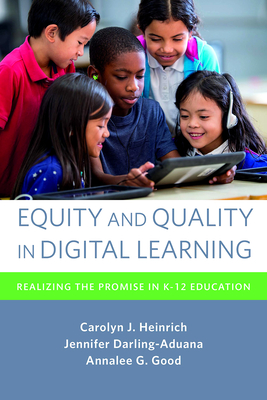
Equity and Quality in Digital Learning : Realizing the Promise in K-12 Education
Book Details
Format
Paperback / softback
ISBN-10
168253510X
ISBN-13
9781682535103
Publisher
Harvard Educational Publishing Group
Imprint
Harvard Educational Publishing Group
Country of Manufacture
US
Country of Publication
GB
Publication Date
Sep 15th, 2020
Print length
208 Pages
Weight
288 grams
Dimensions
15.10 x 22.70 x 1.40 cms
Product Classification:
Philosophy & theory of educationPhilosophy and theory of educationOpen learning, distance educationOpen learning, home learning, distance educationIndustrial or vocational trainingEducational equipment & technology, computer-aided learning (CAL)Educational equipment and technology, computer-aided learning (CAL)
KSh 4,400.00
Temporarily out of stock, due soon
0 in stock
Delivery Location
Delivery fee: Select location
Secure
Quality
Fast
Identifies and presents specific strategies and practices for using digital tools to reduce inequities in educational opportunities and improve student outcomes. The book highlights the factors that can support or impede the effective implementation of digital learning in K-12 schools at all levels: district, school, classroom, and student.
Equity and Quality in Digital Learning identifies and presents specific strategies and practices for using digital tools to reduce inequities in educational opportunities and improve student outcomes.
Based on the authors' ten-year research-practice partnership with both the Dallas and Milwaukee public school districts, the book highlights the factors that can support or impede the effective implementation of digital learning in K-12 schools at all levels: district, school, classroom, and student. Digital initiatives can boost higher levels of learning, the authors advocate, but require planning, monitoring and assessment, and revamping and refinement.
As public schools in the United States continue to make major investments in digital learning, the variability in how it's rolled out, accessed, and supported, both during and outside of the regular school day, threatens to exacerbate rather than reduce inequities in learning opportunities, the authors argue. It is critical to ensure that the chosen digital tools are effectively leveraged to enhance learning and reduce achievement gaps, especially for those students historically underserved in K–12 schools. The authors offer concrete ways to use evidence from the book to increase the effectiveness of digital learning.
Equity and Quality in Digital Learning contributes critical insights and tools needed for educators and policy makers to deliver on the promise of digital learning in American schools.
Based on the authors' ten-year research-practice partnership with both the Dallas and Milwaukee public school districts, the book highlights the factors that can support or impede the effective implementation of digital learning in K-12 schools at all levels: district, school, classroom, and student. Digital initiatives can boost higher levels of learning, the authors advocate, but require planning, monitoring and assessment, and revamping and refinement.
As public schools in the United States continue to make major investments in digital learning, the variability in how it's rolled out, accessed, and supported, both during and outside of the regular school day, threatens to exacerbate rather than reduce inequities in learning opportunities, the authors argue. It is critical to ensure that the chosen digital tools are effectively leveraged to enhance learning and reduce achievement gaps, especially for those students historically underserved in K–12 schools. The authors offer concrete ways to use evidence from the book to increase the effectiveness of digital learning.
Equity and Quality in Digital Learning contributes critical insights and tools needed for educators and policy makers to deliver on the promise of digital learning in American schools.
Get Equity and Quality in Digital Learning by Annalee G. Good, Carolyn J. Heinrich at the best price and quality guaranteed only at Werezi Africa's largest book ecommerce store. The book was published by Harvard Educational Publishing Group and it has 208 pages.
Customers Who Bought This Also Bought

Pedagogy of the Oppressed
KSh 2,000.00

Xrepublic
KSh 850.00

Xrepublic
KSh 1,450.00

Reinventing Pedagogy of the Oppressed
KSh 4,850.00

Student Guide to Freire''s ''Pedagogy of the Oppressed''
KSh 3,150.00

Secondary English for Generation Alpha
KSh 7,900.00

Crazy Faith Workbook
KSh 2,500.00
Narrative Inquiry – Experience and Story in Qualitative Research
KSh 4,850.00
Manipulating Practices
KSh 7,900.00

Emile, Ou de l'Education (3e Ed) (Ed.1882)
KSh 2,150.00

Education and the Social Order
KSh 27,550.00

Fanon and Education
KSh 5,250.00
More by Annalee G. Good, Carolyn J. Heinrich

Teachers As Policy Advocates
KSh 6,500.00

Equal Scrutiny
KSh 8,650.00

Teachers As Policy Advocates
KSh 19,450.00

Improving Governance
KSh 25,900.00

Improving Governance
KSh 8,650.00

Equal Scrutiny
KSh 4,450.00

Mixed Methods for Policy Research and Program Evaluation
KSh 16,750.00

Teachers at the Table
KSh 7,450.00
