
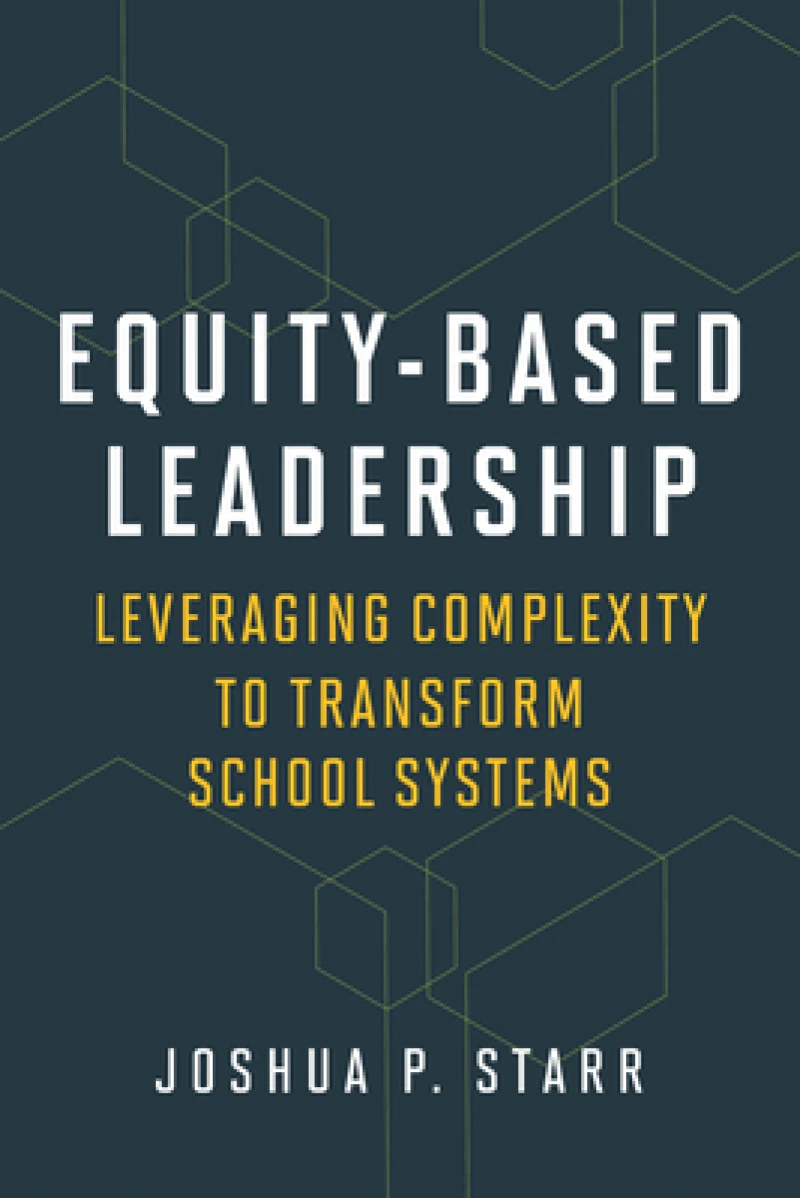
Equity-Based Leadership : Leveraging Complexity to Transform School Systems
Book Details
Format
Paperback / Softback
ISBN-10
1682537285
ISBN-13
9781682537282
Publisher
Harvard Educational Publishing Group
Imprint
Harvard Educational Publishing Group
Country of Manufacture
GB
Country of Publication
GB
Publication Date
May 31st, 2022
Print length
260 Pages
Weight
284 grams
Dimensions
15.20 x 22.70 x 1.30 cms
Ksh 7,000.00
Werezi Extended Catalogue
Delivery in 14 days
1 copies in stock
Delivery Location
Delivery fee: Select location
Delivery in 14 days
Secure
Quality
Fast
In this ambitious yet pragmatic work, Joshua Starr makes the case that intentional and attentive district leadership can bring about continuous improvement in schools. When district reforms are conceived with social justice in mind, Starr explains, schools move toward fulfilling the longstanding promise of equitable education in America.
With a visionary approach to school improvement, Equity-Based Leadership proposes a framework to support system leaders seeking to organize change and achieve more equitable education.
In this ambitious yet pragmatic work, Joshua P. Starr makes the case that intentional and attentive district leadership can bring about continuous improvement in schools. When district reforms are conceived with social justice in mind, Starr explains, schools move toward fulfilling the longstanding promise of equitable education in America.
Starr asserts that the essential goal of good system leadership lies in designing, implementing, and sustaining comprehensive strategies for school reform, in collaboration with school leaders, educators, and community shareholders. Drawing on his own experiences and those of other distinguished superintendents, he offers core practices that system leaders can use to ensure that the mission of their district is upheld throughout any change process and that precious time and funding are used judiciously.
Recognizing that there is no single path to transformation, Starr sets forth a flexible, customizable agenda for district reform that concentrates on six elements, or entry points. Starr's first entry point is curriculum content, as teaching and learning are the fundamental goals of a school system. But he goes further to advocate for a deep dive into the organization and alignment of the system itself, via deliberate support of shared values; explicit and transparent decision-making; resource allocation in line with vision and need; talent management to achieve new levels of educator performance; and nourishment of school culture.
Additionally, Starr brings together a wide range of real-world examples, evidence-based practices, and sensible advice to guide district leaders in aligning their systems around a coherent equity strategy.
This bold new approach to transforming educational systems confidently guides the higher-level decision-making of leaders—not only superintendents but also school board members, cabinet members, and central office administrators—within the context of district-wide efforts to make education better for all students.
In this ambitious yet pragmatic work, Joshua P. Starr makes the case that intentional and attentive district leadership can bring about continuous improvement in schools. When district reforms are conceived with social justice in mind, Starr explains, schools move toward fulfilling the longstanding promise of equitable education in America.
Starr asserts that the essential goal of good system leadership lies in designing, implementing, and sustaining comprehensive strategies for school reform, in collaboration with school leaders, educators, and community shareholders. Drawing on his own experiences and those of other distinguished superintendents, he offers core practices that system leaders can use to ensure that the mission of their district is upheld throughout any change process and that precious time and funding are used judiciously.
Recognizing that there is no single path to transformation, Starr sets forth a flexible, customizable agenda for district reform that concentrates on six elements, or entry points. Starr's first entry point is curriculum content, as teaching and learning are the fundamental goals of a school system. But he goes further to advocate for a deep dive into the organization and alignment of the system itself, via deliberate support of shared values; explicit and transparent decision-making; resource allocation in line with vision and need; talent management to achieve new levels of educator performance; and nourishment of school culture.
Additionally, Starr brings together a wide range of real-world examples, evidence-based practices, and sensible advice to guide district leaders in aligning their systems around a coherent equity strategy.
This bold new approach to transforming educational systems confidently guides the higher-level decision-making of leaders—not only superintendents but also school board members, cabinet members, and central office administrators—within the context of district-wide efforts to make education better for all students.
Get Equity-Based Leadership by at the best price and quality guaranteed only at Werezi Africa's largest book ecommerce store. The book was published by Harvard Educational Publishing Group and it has pages.

