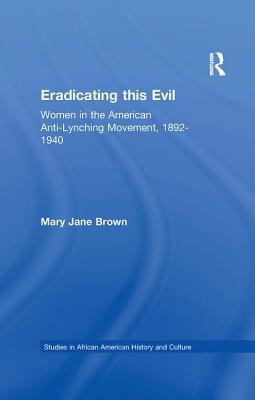
Eradicating this Evil : Women in the American Anti-Lynching Movement, 1892-1940
Book Details
Format
Paperback / softback
Book Series
Studies in African American History and Culture
ISBN-10
1138968927
ISBN-13
9781138968929
Publisher
Taylor & Francis Ltd
Imprint
Routledge
Country of Manufacture
GB
Country of Publication
GB
Publication Date
Apr 27th, 2016
Print length
368 Pages
Weight
453 grams
KSh 9,900.00
Currently unavailable
0 in stock
Delivery Location
Delivery fee: Select location
Secure
Quality
Fast
Rather than discussing one aspect of women''s anti-lynching activism, this book examines the subject in its entirety, from the 1890s to 1940s. It also discusses how differing goals and perceptions of the problem led to conflict within the movement. In the last decade of the nineteenth century, black women began a protest against lynching that eventually swelled into a sizable movement. Ida B. Wells, one of the fist anti-lynching advocates, attacked the notion that lynching protected white women, proving with statistics that most men who were lynched were never even accused of rape but were hung for a variety of real or concocted offenses. Wells'' fight against lynching included a strategy of investigation and exposure that eventually became the template for all anti-lynching activism. The founding of the National Association for the Advancement of Colored People in 1909 drew women of both races into the anti-lynching fight. In the 1920s, the NAACP began an unsuccessful two decade battle for federal anti-lynching legislation that brought the spotlight of public scrutiny to lynching. In the 1930s, a large group of southern white women organized under the leadership of Jessie Daniel Ames to reject the protection that lynching supposedly offered in their name. Organized as the Association of Southern Women for the Prevention of Lynching, the women were opposed to a federal law, yet sought to eradicate lynching through education and by engaging the support of local law officials. The decline of lynching in the late 1930s resulted from a combination of social and political factors; but women anti-lynching activists had an undeniable impact on helping bring about the decline of lynching. (Ph.D. dissertation, Ohio State University, 1998; revised with new preface, bibliography, and index)
Get Eradicating this Evil by Mary Jane Brown at the best price and quality guaranteed only at Werezi Africa's largest book ecommerce store. The book was published by Taylor & Francis Ltd and it has 368 pages.
Customers Who Bought This Also Bought
Born in Blackness – Africa, Africans, and the Making of the Modern World, 1471 to the Second World War
KSh 2,950.00

Migrations
KSh 5,450.00

The Lost City of Z
KSh 2,000.00

On War
KSh 1,200.00

The Lumumba Plot
KSh 3,050.00

Boer War
KSh 3,400.00
The Lessons of History
KSh 1,800.00

White Nights and Other Stories
KSh 3,900.00

A New World Begins
KSh 3,950.00

Reformation
KSh 3,400.00

Hiroshima Men
KSh 4,500.00

Genius Myth
KSh 3,050.00