
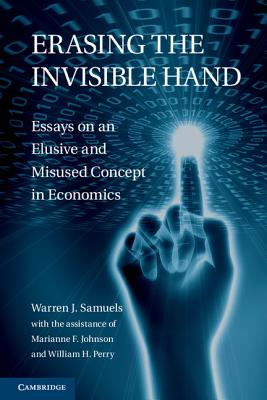
Erasing the Invisible Hand : Essays on an Elusive and Misused Concept in Economics
Book Details
Format
Hardback
ISBN-10
0521517257
ISBN-13
9780521517256
Publisher
Cambridge University Press
Imprint
Cambridge University Press
Country of Manufacture
GB
Country of Publication
GB
Publication Date
Sep 12th, 2011
Print length
358 Pages
Weight
674 grams
Dimensions
23.60 x 16.30 x 3.00 cms
KSh 21,600.00
Currently unavailable
0 in stock
Delivery Location
Delivery fee: Select location
Secure
Quality
Fast
This book examines the use, principally in economics, of the concept of the invisible hand, centering on Adam Smith. It interprets the concept as ideology, knowledge, and a linguistic phenomenon. It shows how the principal Chicago School interpretation misperceives and distorts what Smith believed on the economic role of government.
This book examines the use, principally in economics, of the concept of the invisible hand, centering on Adam Smith. It interprets the concept as ideology, knowledge, and a linguistic phenomenon. It shows how the principal Chicago School interpretation misperceives and distorts what Smith believed on the economic role of government. The essays further show how Smith was silent as to his intended meaning, using the term to set minds at rest; how the claim that the invisible hand is the foundational concept of economics is repudiated by numerous leading economic theorists; that several dozen identities given the invisible hand renders the term ambiguous and inconclusive; that no such thing as an invisible hand exists; and that calling something an invisible hand adds nothing to knowledge. Finally, the essays show that the leading doctrines purporting to claim an invisible hand for the case for capitalism cannot invoke the term but that other nonnormative invisible hand processes are still useful tools.
Get Erasing the Invisible Hand by Warren J. Samuels at the best price and quality guaranteed only at Werezi Africa's largest book ecommerce store. The book was published by Cambridge University Press and it has 358 pages.
Customers Who Bought This Also Bought

Decolonizing Language and Other Revolutionary Ideas
KSh 2,350.00

How to Read a Book
KSh 2,000.00
Decolonizing Language and Other Revolutionary Ideas
KSh 3,600.00

Creative Act
KSh 3,250.00

Groundwork for the Metaphysics of Morals
KSh 2,000.00

Things in Nature Merely
KSh 2,000.00

Meditations – The Philosophy Classic
KSh 2,150.00

Great Ideas Social Contract
KSh 1,450.00

How to Be a Leader – An Ancient Guide to Wise Leadership
KSh 2,800.00

The Daily Laws
KSh 2,350.00

Three Critiques, 3-volume Set
KSh 14,000.00

Philosophical Dictionary
KSh 2,700.00
More by Warren J. Samuels

Essays on the Economic Role of Government
KSh 8,100.00

Essays in the History of Heterodox Political Economy
KSh 8,100.00

Essays on the Methodology and Discourse of Economics
KSh 8,100.00

Essays in the History of Mainstream Political Economy
KSh 23,400.00
Erasing the Invisible Hand
KSh 8,900.00
A Monetary Theory of Employment
KSh 7,150.00
A Monetary Theory of Employment
KSh 4,950.00

The Heterodox Economics of Gardiner C. Means
KSh 37,800.00
Gardiner C. Means
KSh 26,300.00
