
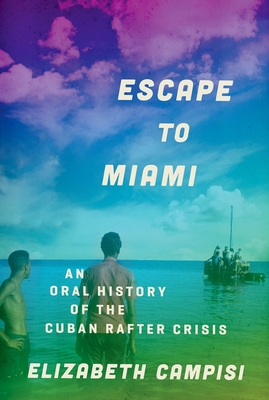
Escape to Miami : An Oral History of the Cuban Rafter Crisis
Book Details
Format
Hardback
Book Series
Oxford Oral History Series
ISBN-10
0199946876
ISBN-13
9780199946877
Publisher
Oxford University Press Inc
Imprint
Oxford University Press Inc
Country of Manufacture
GB
Country of Publication
GB
Publication Date
Jun 30th, 2016
Print length
232 Pages
Weight
458 grams
Dimensions
16.30 x 24.20 x 2.40 cms
KSh 6,700.00
Temporarily out of stock, due soon
0 in stock
Delivery Location
Delivery fee: Select location
Secure
Quality
Fast
Escape to Miami is an oral history of the experience of detainees from Guantanamo during the 1994-1996 Cuban Rafter Crisis. Through life history interviews, the book offers the gripping stories of twelve rafters while also providing a study of group-level trauma and coping. Though important as an oral history, the examination of camp culture makes the project an innovative contribution to the field of anthropology as Campisi argues that coping with trauma experiences as a group can create new cultural forms.
The Naval base in Guantánamo Bay, Cuba has been in the news constantly since the U.S. began using it as a prison camp after the terrorist attacks of September 11, 2001. With all the controversy surrounding the torture of suspects at the prison, its precedent-setting prior use as an immigrant detention center for Haitian and Cuban boat people has been largely overlooked. Overcoming Guantánamo is an oral history of the rafter crisis and the camps written by an anthropologist who worked in the camps. More than a straight oral history, the book is a study of group-level trauma and coping. Using a trauma studies perspective along with discourse-oriented models from anthropology, the book discusses examples of the extensive camp artwork as well as the oral history narratives as part of a meaning-making process that necessarily occurs as people recover from trauma. Campisi worked in the Cuban camps for a year as a temporary employee of the Justice Department''s mediation service, and then returned to analyze the camps from an anthropological point of view. She conducted life history interviews of twelve of the rafters, which included the process of disenchantment with the Revolution, leaving Cuba, the rafting trip, life on the base, and their initial experiences in Cuban Miami, focusing on life on the base. Their stories are gripping. Some people provided disturbing accounts of military abuses, which is an ancillary reason that Overcoming Guantánamo is important right now: human rights violations that occurred at the prison for terror suspects also occurred in the Cuban and Haitian camps, but few people know about them. All such violations should be taken into account in current debates about the use of the base.While it is important as an oral history, the book''s examination of the camp culture also makes it a new contribution to the field of anthropology. Campisi argues that because trauma has cognitive and emotional impacts that require an individual to create new meanings, when people work through individually-traumatic experiences as a group, the new meanings they generate together create new cultural forms. Hence, social trauma can be culturally generative. In these times, that is an important conclusion.
Get Escape to Miami by Elizabeth Campisi at the best price and quality guaranteed only at Werezi Africa's largest book ecommerce store. The book was published by Oxford University Press Inc and it has 232 pages.
Customers Who Bought This Also Bought
Crusade for Justice – The Autobiography of Ida B. Wells, Second Edition
KSh 4,050.00

Killers of the Flower Moon
KSh 2,000.00

Warmth of Other Suns
KSh 3,050.00

Frederick Douglass
KSh 3,350.00

107 Days
KSh 4,500.00

Second Treatise of Government – Norton Library
KSh 1,600.00

Tuesdays With Morrie
KSh 2,000.00
My Bondage and My Freedom
KSh 1,600.00

Hidden Figures
KSh 2,000.00

America, América
KSh 3,650.00

Holding the Line
KSh 2,000.00
Nuclear Folly
KSh 3,050.00

