
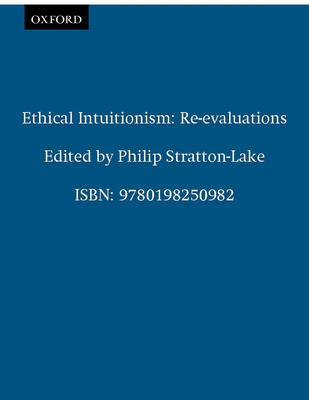
Ethical Intuitionism : Re-evaluations
Book Details
Format
Paperback / softback
ISBN-10
0198250983
ISBN-13
9780198250982
Publisher
Oxford University Press
Imprint
Oxford University Press
Country of Manufacture
GB
Country of Publication
GB
Publication Date
Aug 15th, 2002
Print length
314 Pages
Weight
458 grams
Dimensions
23.30 x 15.60 x 1.70 cms
Product Classification:
Ethics & moral philosophy
KSh 9,400.00
Temporarily out of stock, due soon
0 in stock
Delivery Location
Delivery fee: Select location
Secure
Quality
Fast
Ethical intuitionism was the dominant moral theory in Britain for much of the 18th, 19th and the first third of the 20th century, before coming to be regarded as utterly untenable. Here, moral philosophers clarify and assess ethical intuitionism in the light of contemporary developments in theory.
Ethical Intuitionism was the dominant moral theory in Britain for much of the eighteenth and nineteenth and the first third of the twentieth century. However, during the middle decades of the twentieth century ethical intuitionism came to be regarded as utterly untenable. It was thought to be either empty, or metaphysically and epistemologically extravagant, or both. This hostility led to a neglect of the central intuitionist texts, and encouraged the growth of a caricature of intuitionism that could easily be rejected before moving on to ''more serious'' philosophical theories. More recently, however, this hostility towards ethical intuitionism has subsided. A wide range of moral philosophers, from Aristotelians, to rule-consequentialists, to expressivists, Kantians, and deontologists, are beginning to look to the ethical intuitionists'' work as a positive resource. It is, therefore, a good time to get clear on what it was that intuitionists said, and re-evaluate their contribution to our understanding of morality. This volume is the first serious engagement with ethical intuitionism in the light of more recent developments in ethical theory. It contains essays by eminent moral philosophers working in very different traditions whose aim is to clarify and assess ethical intuitionism. Issues addressed include whether the plurality of basic principles intuitionists adhere to can be grounded in some more fundamental principle; the autonomy of ethics and self-evidence; moral realism and internalism; and the open question argument and naturalism.
Get Ethical Intuitionism by Philip Stratton-Lake at the best price and quality guaranteed only at Werezi Africa's largest book ecommerce store. The book was published by Oxford University Press and it has 314 pages.
Customers Who Bought This Also Bought
Xmeditations
KSh 700.00

Groundwork for the Metaphysics of Morals
KSh 2,000.00

On the Genealogy of Morals
KSh 2,000.00

Beyond Good and Evil
KSh 2,000.00
The Nicomachean Ethics
KSh 1,600.00

The Sovereignty of Good
KSh 5,400.00

Justice
KSh 2,000.00
Meditations
KSh 1,600.00
What We Owe The Future
KSh 2,000.00
The Analects
KSh 2,350.00
How to Be a Leader – An Ancient Guide to Wise Leadership
KSh 2,800.00

There Are Places in the World Where Rules Are Less Important Than Kindness
KSh 3,600.00
