
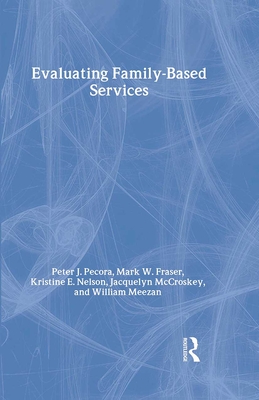
Evaluating Family-Based Services
Book Details
Format
Hardback
ISBN-10
0202360938
ISBN-13
9780202360935
Publisher
Taylor & Francis Inc
Imprint
AldineTransaction
Country of Manufacture
US
Country of Publication
GB
Publication Date
Dec 31st, 1995
Print length
315 Pages
Weight
453 grams
Product Classification:
Welfare & benefit systems
KSh 15,100.00
Re-Printing
0 in stock
Delivery Location
Delivery fee: Select location
Secure
Quality
Fast
Family-based service (FBS) programs have been developing rapidly across the country at a time of increasingly scarce human resources and in a politically volatile climate. Such a context has made evaluation of such programs imperative. The present volume reviews basic elements of evaluation in the light of current knowledge and then highlights the most useful research instruments for measuring changes in child and family functioning. Chapters focus on evaluation methods that can be employed to determine the success of existing policy and to influence the development of new policy. The authors assume that their readers will have a basic familiarity with research methods and program evaluation. They discuss the challenges they have encountered in conducting extensive research on family preservation, family support. and other related programs and pose practical solutions for administrators, practitioners, and evaluators confronted with similar difficult issues. Each chapter presents a brief conceptual framework for understanding issues related to assessment. Essential elements are reviewed, while research design, measurement variables, and qualitative and quantitative analyses are discussed in turn. The book concludes with a review of the limitations of evaluations.
Family-based service (FBS) programs have been developing rapidly across the country at a time of increasingly scarce human resources and in a politically volatile climate. Such a context has made evaluation of such programs imperative. The present volume reviews basic elements of evaluation in the light of current knowledge and then highlights the most useful research instruments for measuring changes in child and family functioning. Chapters focus on evaluation methods that can be employed to determine the success of existing policy and to influence the development of new policy. The authors assume that their readers will have a basic familiarity with research methods and program evaluation. They discuss the challenges they have encountered in conducting extensive research on family preservation, family support. and other related programs and pose practical solutions for administrators, practitioners, and evaluators confronted with similar difficult issues. Each chapter presents a brief conceptual framework for understanding issues related to assessment. Essential elements are reviewed, while research design, measurement variables, and qualitative and quantitative analyses are discussed in turn. The book concludes with a review of the limitations of evaluations.
Get Evaluating Family-Based Services by Peter J. Pecora at the best price and quality guaranteed only at Werezi Africa's largest book ecommerce store. The book was published by Taylor & Francis Inc and it has 315 pages.
Customers Who Bought This Also Bought
Social Security and Retirement around the World
KSh 14,500.00
Social Security Programs and Retirement around t – Fiscal Implications of Reform
KSh 18,000.00
Social Security Programs and Retirement around t – Micro–Estimation
KSh 19,500.00

Social Protection Landscape and Perspectives
KSh 5,900.00
Welfare''s End
KSh 5,600.00
Dividing Citizens
KSh 6,850.00

From Company Doctors to Managed Care
KSh 5,950.00

Unsocial Europe
KSh 5,750.00
Welfare Reform
KSh 10,800.00
Linking Housing and Services for Older Adults
KSh 32,750.00
Working and Caring for a Child with Chronic Illness
KSh 8,100.00
Welfare State Transformations and Inequality in OECD Countries
KSh 14,400.00
More in This Genre
Social Security and Retirement around the World
KSh 14,500.00
Social Security Programs and Retirement around t – Fiscal Implications of Reform
KSh 18,000.00
Social Security Programs and Retirement around t – Micro–Estimation
KSh 19,500.00
Social Protection Landscape and Perspectives
KSh 5,900.00
Welfare''s End
KSh 5,600.00
Dividing Citizens
KSh 6,850.00
