
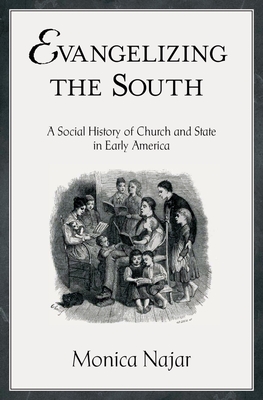
Evangelizing the South
by
Monica Najar
Book Details
Format
Hardback
Book Series
Religion in America
ISBN-10
0195309006
ISBN-13
9780195309003
Publisher
Oxford University Press Inc
Imprint
Oxford University Press Inc
Country of Manufacture
US
Country of Publication
GB
Publication Date
Feb 28th, 2008
Print length
264 Pages
Weight
539 grams
Dimensions
15.50 x 23.40 x 2.80 cms
Product Classification:
Church historyChristian mission & evangelism
KSh 16,800.00
Temporarily out of stock, due soon
0 in stock
Delivery Location
Delivery fee: Select location
Secure
Quality
Fast
Although many refer to the American South as the "Bible Belt", the region was not always characterized by a powerful religious culture. In the seventeenth century and early eighteenth century, religion-in terms both of church membership and personal piety-was virtually absent from southern culture. The late eighteenth century and early nineteenth century, however, witnessed the astonishingly rapid rise of evangelical religion in the Upper South. Within just a few years, evangelicals had spread their beliefs and their fervor, gaining converts and building churches throughout Virginia and North Carolina and into the western regions. But what was it that made evangelicalism so attractive to a region previously uninterested in religion? Monica Najar argues that early evangelicals successfully negotiated the various challenges of the eighteenth-century landscape by creating churches that functioned as civil as well as religious bodies. The evangelical church of the late eighteenth century was the cornerstone of its community, regulating marriages, monitoring prices, arbitrating business, and settling disputes. As the era experienced substantial rifts in the relationship between church and state, the disestablishment of colonial churches paved the way for new formulations of church-state relations. The evangelical churches were well-positioned to provide guidance in uncertain times, and their multiple functions allowed them to reshape many of the central elements of authority in southern society. They assisted in reformulating the lines between the "religious" and "secular" realms, with significant consequences for both religion and the emerging nation-state. Touching on the creation of a distinctive southern culture, the position of women in the private and public arenas, family life in the Old South, the relationship between religion and slavery, and the political culture of the early republic, Najar reveals the history behind a religious heritage that remains a distinguishing mark of American society.
Although many refer to the American South as the "Bible Belt", the region was not always characterized by a powerful religious culture. In the seventeenth century and early eighteenth century, religion-in terms both of church membership and personal piety-was virtually absent from southern culture. The late eighteenth century and early nineteenth century, however, witnessed the astonishingly rapid rise of evangelical religion in the Upper South. Within just a few years, evangelicals had spread their beliefs and their fervor, gaining converts and building churches throughout Virginia and North Carolina and into the western regions. But what was it that made evangelicalism so attractive to a region previously uninterested in religion? Monica Najar argues that early evangelicals successfully negotiated the various challenges of the eighteenth-century landscape by creating churches that functioned as civil as well as religious bodies. The evangelical church of the late eighteenth century was the cornerstone of its community, regulating marriages, monitoring prices, arbitrating business, and settling disputes. As the era experienced substantial rifts in the relationship between church and state, the disestablishment of colonial churches paved the way for new formulations of church-state relations. The evangelical churches were well-positioned to provide guidance in uncertain times, and their multiple functions allowed them to reshape many of the central elements of authority in southern society. They assisted in reformulating the lines between the "religious" and "secular" realms, with significant consequences for both religion and the emerging nation-state. Touching on the creation of a distinctive southern culture, the position of women in the private and public arenas, family life in the Old South, the relationship between religion and slavery, and the political culture of the early republic, Najar reveals the history behind a religious heritage that remains a distinguishing mark of American society.
Get Evangelizing the South by Monica Najar at the best price and quality guaranteed only at Werezi Africa's largest book ecommerce store. The book was published by Oxford University Press Inc and it has 264 pages.
Customers Who Bought This Also Bought

Tudor Church Militant
KSh 2,350.00

All Things Made New
KSh 3,050.00

The Metaphysics of the Incarnation
KSh 20,250.00

The Power and The Glory
KSh 6,950.00

The Secret History of Christianity
KSh 3,250.00

Documents of the English Reformation
KSh 9,450.00

The Jew, the Cathedral and the Medieval City
KSh 7,550.00

The Early Christian Church
KSh 8,200.00

Religion and the Early Modern State
KSh 20,500.00

The Ashgate Research Companion to Byzantine Hagiography
KSh 30,950.00

Edmund Campion
KSh 8,650.00

Movement or Moment?
KSh 9,700.00
