
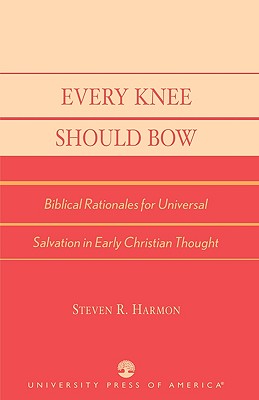
Every Knee Should Bow : Biblical Rationales for Universal Salvation in Early Christian Thought
Book Details
Format
Paperback / softback
ISBN-10
0761827196
ISBN-13
9780761827191
Publisher
University Press of America
Imprint
University Press of America
Country of Manufacture
GB
Country of Publication
GB
Publication Date
Nov 17th, 2003
Print length
180 Pages
Weight
250 grams
Dimensions
21.50 x 14.00 x 1.30 cms
Product Classification:
Religion: generalChristian theologyReligion: generalChristianity
KSh 11,550.00
Currently unavailable
0 in stock
Delivery Location
Delivery fee: Select location
Secure
Quality
Fast
In Every Knee Should Bow, Steven Harmon explores the manner in which Clement of Alexandria (ca. 160-215 C.E.), Origen (ca. 185-ca. 251 C.E.), and Gregory of Nyssa (331/340-ca. 395 C.E.) appealed to Scripture in developing rationales for their concepts of apokatastasis, the hope that all rational creatures will ultimately be reconciled to God. Harmon argues that these patristic universalists maintained their hope for "a wideness in God''s mercy" primarily because they believed this hope was the most coherent reading of the biblical story.
Get Every Knee Should Bow by Steven R. Harmon at the best price and quality guaranteed only at Werezi Africa's largest book ecommerce store. The book was published by University Press of America and it has 180 pages.
Customers Who Bought This Also Bought
Comfortable with Uncertainty
KSh 3,050.00

Religions Book
KSh 4,350.00
The Psychology of Selling
KSh 2,700.00
Consolations from a Stoic
KSh 3,900.00

Muhammad
KSh 2,350.00

Inner Chapters
KSh 3,800.00
Peace of Mind
KSh 3,900.00

On the Shoulders of Giants
KSh 5,400.00

Hinds' Feet on High Places
KSh 2,350.00

Lost Art of Scripture
KSh 2,700.00
Preaching Eugenics
KSh 16,850.00

Praying for Power
KSh 6,850.00
