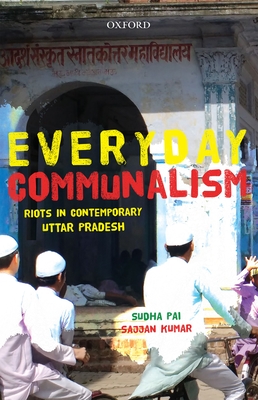
Everyday Communalism : Riots in Contemporary Uttar Pradesh
Book Details
Format
Hardback
ISBN-10
0199466297
ISBN-13
9780199466290
Publisher
OUP India
Imprint
OUP India
Country of Manufacture
IN
Country of Publication
GB
Publication Date
Oct 25th, 2018
Print length
368 Pages
Weight
436 grams
Dimensions
22.20 x 14.80 x 2.80 cms
Product Classification:
SociologyPolitical science & theory
KSh 7,350.00
Currently unavailable
0 in stock
Delivery Location
Delivery fee: Select location
Secure
Quality
Fast
Everyday Communalism not only attempts to explore the anatomy of a Hindu-Muslim riot and its aftermath, but also examines the inner workings that enable deep-seated polarization between communities. Pai and Kumar show that frequent, low-intensity communal clashes pegged on routine everyday issues and resources help establish a permanent anti-Muslim prejudice among Hindus legitimizing majoritarian rule in the eyes of an increasingly polarized, intolerant, and entitled majority community of Hindus. Uttar Pradesh''s rising cultural aspirations; economic anxieties to move away from its traditionally backward status; a deep caste-marked agrarian crisis; and sharp inequalities and acute poverty further play into the making a new post-Ayodhya phase of Hindutva politics.
With the demolition of the Babri Masjid and subsequent riots of the late 1980s and 1990s in Uttar Pradesh, the period that followed appeared relatively peaceful. Only at the turn of the century, India witnessed a strong wave of communalism in early 2000s. After the Godhra riots of Gujarat in 2002, Uttar Pradesh saw a series of them--in Mau in 2005, Lucknow in 2006, Gorakhpur in 2007, and Muzaffarnagar in 2013--announcing the return of fundamentalism in the Bharatiya Janta Party''s core agenda of Hindutva politics. Everyday Communalism not only attempts to explore the anatomy of a Hindu-Muslim riot and its aftermath, but also examines the inner workings that enable deep-seated polarization between communities. Pai and Kumar show that frequent, low-intensity communal clashes pegged on routine everyday issues and resources help establish a permanent anti-Muslim prejudice among Hindus legitimizing majoritarian rule in the eyes of an increasingly polarized, intolerant, and entitled majority community of Hindus. Uttar Pradesh''s rising cultural aspirations; economic anxieties to move away from its traditionally backward status; a deep caste-marked agrarian crisis; and sharp inequalities and acute poverty further play into the making a new post-Ayodhya phase of Hindutva politics.
Get Everyday Communalism by Sajjan Kumar, Sudha Pai at the best price and quality guaranteed only at Werezi Africa's largest book ecommerce store. The book was published by OUP India and it has 368 pages.
Customers Who Bought This Also Bought
Caste
KSh 2,700.00

On Freedom
KSh 2,350.00

Extinction of Experience
KSh 3,950.00

Revenge of the Tipping Point
KSh 2,350.00

Lost Girls
KSh 2,000.00

Right to Sex
KSh 2,000.00
Caste
KSh 4,550.00

Revenge of the Tipping Point
KSh 4,500.00

Revenge of the Tipping Point
KSh 3,050.00

Can Feminism Be African
KSh 2,000.00

Can Feminism Be African
KSh 3,950.00

History of Sexuality: 2
KSh 2,350.00