
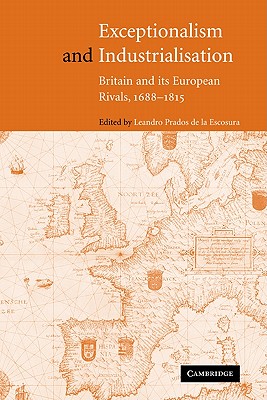
Exceptionalism and Industrialisation : Britain and its European Rivals, 1688–1815
Book Details
Format
Paperback / softback
ISBN-10
0521189691
ISBN-13
9780521189699
Publisher
Cambridge University Press
Imprint
Cambridge University Press
Country of Manufacture
GB
Country of Publication
GB
Publication Date
Sep 22nd, 2011
Print length
352 Pages
Weight
524 grams
Dimensions
15.00 x 22.80 x 2.50 cms
Product Classification:
British & Irish historyModern history to 20th century: c 1700 to c 1900Colonialism & imperialismNational liberation & independence, post-colonialismEconomic historyHistoryEuropean historyColonialism and imperialismNational liberation and independenceMaritime / nautical tradesMaritime and nautical trades
KSh 8,750.00
Currently unavailable
0 in stock
Delivery Location
Delivery fee: Select location
Secure
Quality
Fast
This 2004 book discusses British exceptionalism in the period from 1688 to 1815. Leading historians examine why Britain was able to establish hegemony over other European powers and her unique path to industrialisation. Their findings shed light on Britain's emergence as a great power and as the first industrial nation.
This 2004 book explores the question of British exceptionalism in the period from the Glorious Revolution to the Congress of Vienna. Leading historians examine why Great Britain emerged from years of sustained competition with its European rivals in a discernible position of hegemony in the domains of naval power, empire, global commerce, agricultural efficiency, industrial production, fiscal capacity and advanced technology. They deal with Britain's unique path to industrial revolution and distinguish four themes on the interactions between its emergence as a great power and as the first industrial nation. First, they highlight growth and industrial change, the interconnections between agriculture, foreign trade and industrialisation. Second, they examine technological change and, especially, Britain's unusual inventiveness. Third, they study her institutions and their role in facilitating economic growth. Fourth and finally, they explore British military and naval supremacy, showing how this was achieved and how it contributed to Britain's economic supremacy.
Get Exceptionalism and Industrialisation by Leandro Prados de la Escosura at the best price and quality guaranteed only at Werezi Africa's largest book ecommerce store. The book was published by Cambridge University Press and it has 352 pages.
Customers Who Bought This Also Bought

Churchill
KSh 3,700.00

Difficult Women
KSh 2,350.00

Legacy of Violence
KSh 3,150.00
Agricola and the Germania
KSh 2,350.00
Empireland
KSh 2,150.00

The History of the Kings of Britain
KSh 2,350.00

Siege
KSh 2,000.00

Anarchy
KSh 2,700.00
What Matters in Jane Austen?
KSh 2,700.00
Unruly
KSh 2,150.00
Map Of A Nation
KSh 2,350.00

Black and British
KSh 2,350.00
