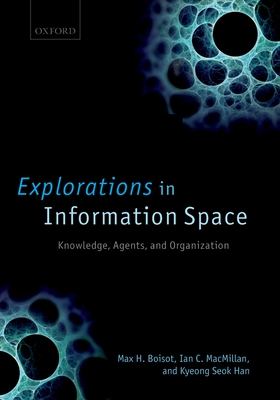
Explorations in Information Space : Knowledge, Agents, and Organization
Book Details
Format
Hardback
ISBN-10
0199250871
ISBN-13
9780199250875
Publisher
Oxford University Press
Imprint
Oxford University Press
Country of Manufacture
GB
Country of Publication
GB
Publication Date
Dec 27th, 2007
Print length
242 Pages
Weight
502 grams
Dimensions
24.20 x 16.50 x 1.60 cms
Product Classification:
Philosophy: epistemology & theory of knowledgeEconomicsBusiness & management
KSh 17,300.00
Temporarily out of stock, due soon
0 in stock
Delivery Location
Delivery fee: Select location
Secure
Quality
Fast
With the rise of the knowledge economy, the knowledge content of goods and services is going up just as their material content is declining. Economic value is increasingly seen to reside in intangible assets, rather than material. This book explores the framework of 'I-Space' - a theoretical approach to the production and distribution of knowledge.
With the rise of the knowledge economy, the knowledge content of goods and services is going up just as their material content is declining. Economic value is increasingly seen to reside in the former - that is, in intangible assets - rather than in the latter. Yet we keep wanting to turn knowledge back into something tangible, something with definite boundaries which can be measured, manipulated, appropriated, and traded. In short, we want to reify knowledge. Scholars have been debating the nature of knowledge since the time of Plato. Many new insights have been gained from these debates, but little theoretical consensus has been achieved. Through six thematically linked chapters, the book articulates the theoretical approach to the production and distribution of knowledge that underpins Max Boisot''s conceptual framework, the Information Space or I-Space. In this way the book looks to provide theoretical and practical underpinnings to Boisot''s book Knowledge Assets (OUP, 1998).Following an introductory chapter, how knowledge relates to data and information is first examined in chapter 1, and how different economic actors - entrepreneurs, managers, etc - use knowledge as a basis for action is explored in chapter 2. Chapter 3 looks at how the heterogeneity of economic actors arises naturally from their respective data processing strategies in spite of any similarities in the data that they might share. Chapter 4 argues, contra much transaction-based economics, that an organizational order must have preceded a market order, something that should be reflected in any knowledge-based theory of the firm. Chapter 5 discusses the cultural and institutional significance of different kinds of knowledge flows. Finally, chapter 6 presents an agent-based simulation model, SimISpace, that illustrates how the I-Space might be applied to concrete problems such those of intellectual property rights. A concluding chapter proposes a research agenda based on the theorizing developed in the book.The approach the book sets out is used by a whole range of organizations to issues of knowledge management, policy, economics, and organizational and cultural change.
Get Explorations in Information Space by Ian C. MacMillan, Kyeong Seok Han at the best price and quality guaranteed only at Werezi Africa's largest book ecommerce store. The book was published by Oxford University Press and it has 242 pages.
Customers Who Bought This Also Bought

A Treatise of Human Nature
KSh 2,700.00
Critique of Pure Reason
KSh 3,400.00

Sensuous Knowledge
KSh 4,500.00

Critique of Pure Reason, Abridged
KSh 3,600.00
Sharing Thoughts
KSh 17,000.00

The Critique of Pure Reason
KSh 6,450.00

Critique of Pure Reason
KSh 7,250.00
An Inquiry Into Meaning and Truth
KSh 3,750.00
Intelligence and Spirit
KSh 5,750.00
The Social Construction of What?
KSh 5,200.00

Discourse on Method and Related Writings
KSh 2,000.00

Beyond Good and Evil
KSh 2,000.00