
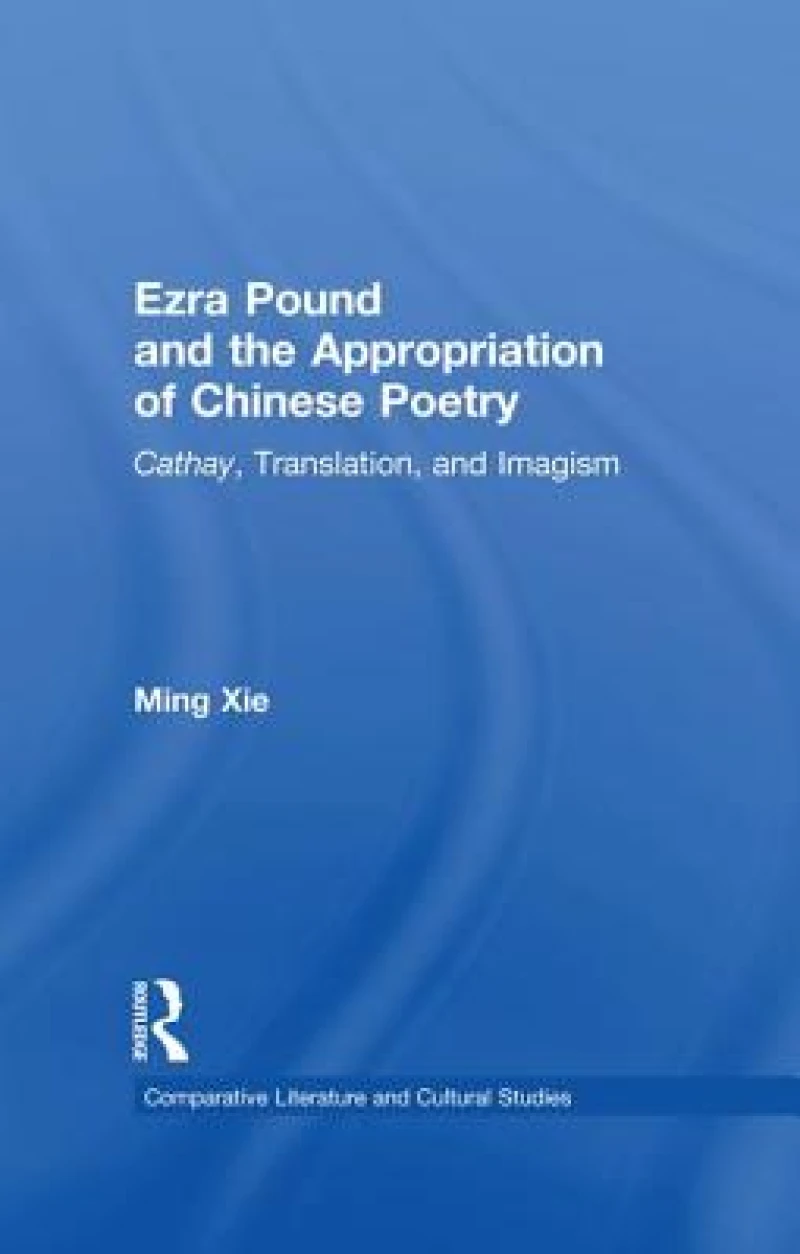
Ezra Pound and the Appropriation of Chinese Poetry : Cathay, Translation, and Imagism
by
Ming Xie
Book Details
Format
Paperback / Softback
Book Series
Comparative Literature and Cultural Studies
ISBN-10
1138001708
ISBN-13
9781138001701
Publisher
Taylor & Francis Ltd
Imprint
Routledge
Country of Manufacture
GB
Country of Publication
GB
Publication Date
Nov 10th, 2014
Print length
279 Pages
Weight
340 grams
Product Classification:
PoetryLiterature: history & criticism
Ksh 10,600.00
Werezi Extended Catalogue
0 in stock
Delivery Location
Delivery fee: Select location
Secure
Quality
Fast
This book focuses on the relations between the translation and appropriation of classical Chinese poetry by Ezra Pound and some of his contemporaries and the development of Anglo-American Imagist poetry and poetics. It is concerned as much with critical aspects of this correlative relationship as with the question of historical influence and ascription. The author places the early work of Ezra Pound in the context of works of Chinese translation by other contemporary poet-translators such as Arthur Waley and Amy Lowell, and examines the whole notion of an ideogrammic poetry as advocated by Ernest Fenollosa and Ezra Pound against an appropriately reconstructed historical and critical context of poetic theory and practice. Closely linked to this is a discussion of Pound's use of personae and modulation of the elegiac in relation to the immediately preceding context of late Victorian elegiac lyricism and Brownigesque dramatic monologue. Through a series of close readings of translations from the Chinese, especially those by Pound, the author shows how the critical problem of what is involved in translating a Chinese poem into a new English poem is closely linked to the particulars of early Modernist literary history. In particular, through tracing the trajectory of a number of central issues and notions, such as absolute, free-floating, metaphor, metaphor as epiphanic image and its relation to syntax, metaphor and parallelism, experiments with rhythm and cadence, the book explores some of the reasons for Fenollosa's and Pound's emphasis on the visual image, the notion of phanopoeia and ideogrammic verbal action as the active perceiving of relations, and closely examines the genesis and significance of Pound's ideogrammic method, as well as the question of cultural misreading and vicarious envisagement, and provides a critical overview of Pound's general engagement with translation.
This book focuses on the relations between the translation and appropriation of classical Chinese poetry by Ezra Pound and some of his contemporaries and the development of Anglo-American Imagist poetry and poetics. It is concerned as much with critical aspects of this correlative relationship as with the question of historical influence and ascription. The author places the early work of Ezra Pound in the context of works of Chinese translation by other contemporary poet-translators such as Arthur Waley and Amy Lowell, and examines the whole notion of an ideogrammic poetry as advocated by Ernest Fenollosa and Ezra Pound against an appropriately reconstructed historical and critical context of poetic theory and practice. Closely linked to this is a discussion of Pound''s use of personae and modulation of the elegiac in relation to the immediately preceding context of late Victorian elegiac lyricism and Brownigesque dramatic monologue. Through a series of close readings of translations from the Chinese, especially those by Pound, the author shows how the critical problem of what is involved in translating a Chinese poem into a new English poem is closely linked to the particulars of early Modernist literary history. In particular, through tracing the trajectory of a number of central issues and notions, such as absolute, free-floating, metaphor, metaphor as epiphanic image and its relation to syntax, metaphor and parallelism, experiments with rhythm and cadence, the book explores some of the reasons for Fenollosa''s and Pound''s emphasis on the visual image, the notion of phanopoeia and ideogrammic verbal action as the active perceiving of relations, and closely examines the genesis and significance of Pound''s ideogrammic method, as well as the question of cultural misreading and vicarious envisagement, and provides a critical overview of Pound''s general engagement with translation.
Get Ezra Pound and the Appropriation of Chinese Poetry by at the best price and quality guaranteed only at Werezi Africa's largest book ecommerce store. The book was published by Taylor & Francis Ltd and it has pages.

