
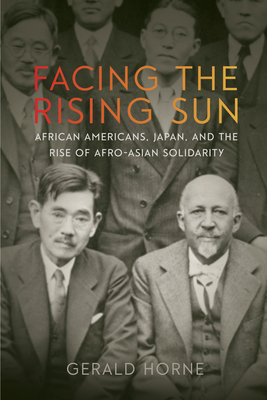
Facing the Rising Sun : African Americans, Japan, and the Rise of Afro-Asian Solidarity
by
Gerald Horne
Book Details
Format
Hardback
ISBN-10
147984859X
ISBN-13
9781479848591
Publisher
New York University Press
Imprint
New York University Press
Country of Manufacture
GB
Country of Publication
GB
Publication Date
Jan 16th, 2018
Print length
277 Pages
Weight
522 grams
Dimensions
16.10 x 23.90 x 2.40 cms
Product Classification:
Asian history20th century history: c 1900 to c 2000
KSh 5,300.00
Currently unavailable
0 in stock
Delivery Location
Delivery fee: Select location
Secure
Quality
Fast
The surprising alliance between Japan and pro-Tokyo African Americans during World War II In November 1942 in East St. Louis, Illinois a group of African Americans engaged in military drills were eagerly awaiting a Japanese invasion of the U.S.— an invasion that they planned to join. Since the rise of Japan as a superpower less than a century earlier, African Americans across class and ideological lines had saluted the Asian nation, not least because they thought its very existence undermined the pervasive notion of "white supremacy." The list of supporters included Booker T. Washington, Marcus Garvey, and particularly W.E.B. Du Bois. Facing the Rising Sun tells the story of the widespread pro-Tokyo sentiment among African Americans during World War II, arguing that the solidarity between the two groups was significantly corrosive to the U.S. war effort. Gerald Horne demonstrates that Black Nationalists of various stripes were the vanguard of this trend—including followers of Garvey and the precursor of the Nation of Islam. Indeed, many of them called themselves "Asiatic", not African. Following World War II, Japanese-influenced "Afro-Asian" solidarity did not die, but rather foreshadowed Dr. Martin Luther King's tie to Gandhi's India and Black Nationalists' post-1970s fascination with Maoist China and Ho's Vietnam. Based upon exhaustive research, including the trial transcripts of the pro-Tokyo African Americans who were tried during the war, congressional archives and records of the Negro press, this book also provides essential background for what many analysts consider the coming "Asian Century." An insightful glimpse into the Black Nationalists' struggle for global leverage and new allies, Facing the Rising Sun provides a complex, holistic perspective on a painful period in African American history, and a unique glimpse into the meaning of "the enemy of my enemy is my friend."
Get Facing the Rising Sun by Gerald Horne at the best price and quality guaranteed only at Werezi Africa's largest book ecommerce store. The book was published by New York University Press and it has 277 pages.
Customers Who Bought This Also Bought

From Third World to First
KSh 3,200.00

Breakneck
KSh 4,500.00

India After Gandhi
KSh 4,850.00

Anarchy
KSh 2,700.00

On China
KSh 3,400.00

Apostles of Development
KSh 5,600.00

Shattered Lands
KSh 2,000.00

Indira Gandhi and the Years that Transformed India
KSh 5,050.00

India: A Wounded Civilization
KSh 2,000.00
Shattered Lands
KSh 3,200.00

Games without Rules
KSh 2,900.00

Ghost Nation
KSh 3,950.00
More by Gerald Horne
Race to Revolution
KSh 3,600.00
Black Liberation / Red Scare
KSh 3,600.00

The World and Africa and Color and Democracy (The Oxford W. E. B. Du Bois)
KSh 4,700.00

Jazz and Justice
KSh 3,950.00
Class Struggle in Hollywood, 1930-1950
KSh 4,850.00

The Apocalypse of Settler Colonialism
KSh 3,600.00

State Of The Union 1994
KSh 12,000.00
Confronting Black Jacobins
KSh 4,050.00

State Of The Union 1994
KSh 7,450.00

The Final Victim of the Blacklist
KSh 5,400.00
The Counter-Revolution of 1776
KSh 4,300.00

I Dare Say
KSh 2,900.00
