
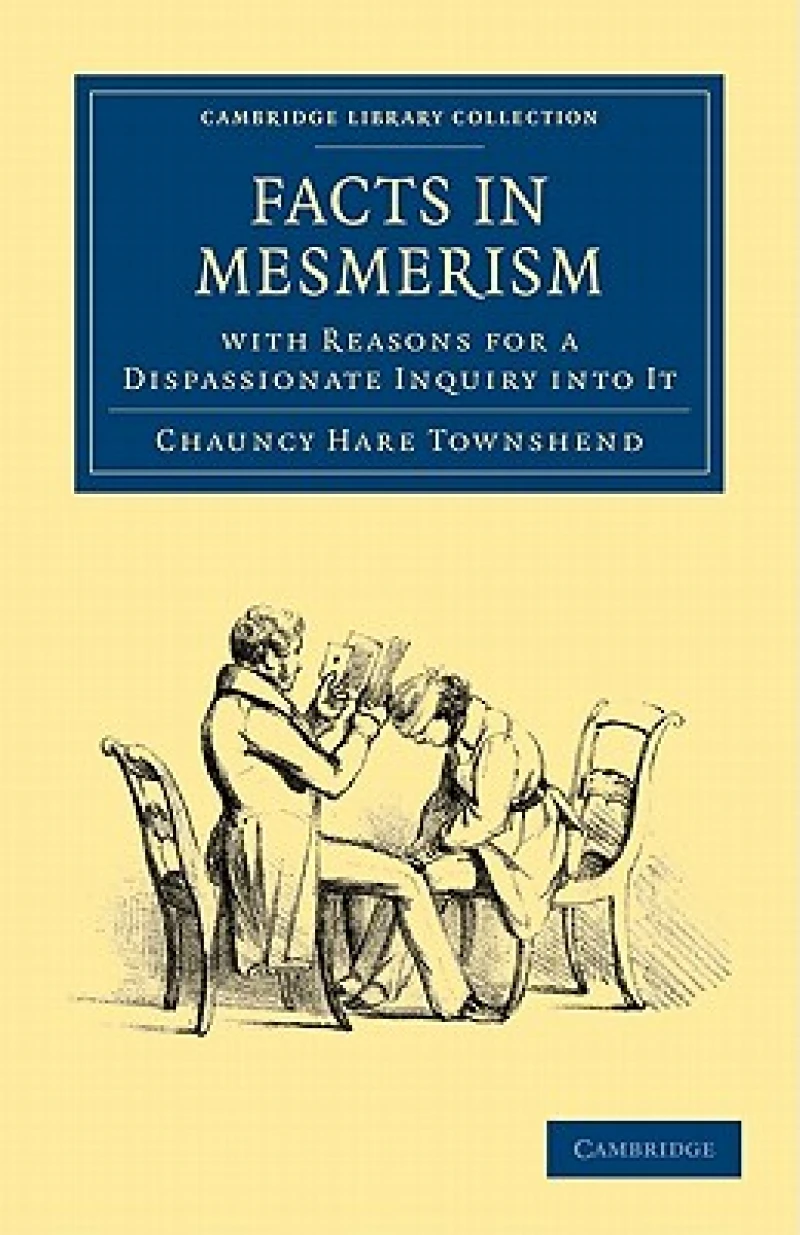
Facts in Mesmerism, with Reasons for a Dispassionate Inquiry Into It
Book Details
Format
Paperback / Softback
ISBN-10
1108025897
ISBN-13
9781108025898
Publisher
Cambridge University Press
Imprint
Cambridge University Press
Country of Manufacture
GB
Country of Publication
GB
Publication Date
Feb 24th, 2011
Print length
598 Pages
Weight
750 grams
Dimensions
21.60 x 14.00 x 3.40 cms
Product Classification:
SpiritualismHistory of ideasHistory of ideasSpiritualism
Ksh 9,200.00
Manufactured on Demand
0 in stock
Delivery Location
Delivery fee: Select location
Secure
Quality
Fast
A passionate defence of Mesmerism, a kind of hypnosis based on the theory of animal magnetism, first published in 1840 by one of its most prominent nineteenth-century practitioners, a friend of Dickens. Townshend includes eye-witness accounts of hypnotic experiments, both from the subject's and the Mesmeriser's viewpoint.
Chauncy Hare Townshend (1798–1868), poet and collector, was a well-connected friend of Robert Southey and Charles Dickens. He became fascinated with Mesmerism while in Germany and went on to popularise it in England. This book, first published in 1840, was his passionate defence of Mesmerism. Developed in the late eighteenth century by Franz Mesmer, Mesmerism was a kind of hypnosis based on the theory of animal magnetism. With its spiritual associations and uncanny effects, it was an extremely controversial topic in the nineteenth century and its practitioners were widely considered fraudsters. Townshend describes in detail the mental states Mesmerism induces, which he identifies as similar to a state of sleepwalking. Perhaps most fascinating are the eye-witness accounts describing experiments carried out by Townshend on the continent, in which he hypnotised his subjects into feeling his own sensations and knowing things they could not know.
Get Facts in Mesmerism, with Reasons for a Dispassionate Inquiry Into It by at the best price and quality guaranteed only at Werezi Africa's largest book ecommerce store. The book was published by Cambridge University Press and it has pages.

