
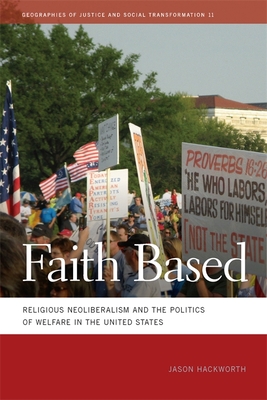
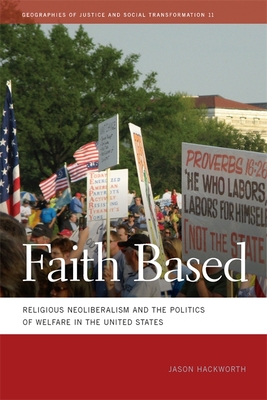
Faith Based : Religious Neoliberalism and the Politics of Welfare in the United States
Book Details
Format
Paperback / softback
Book Series
Geographies of Justice and Social Transformation
ISBN-10
0820343048
ISBN-13
9780820343044
Publisher
University of Georgia Press
Imprint
University of Georgia Press
Country of Manufacture
US
Country of Publication
GB
Publication Date
Jun 1st, 2012
Print length
184 Pages
Weight
295 grams
Dimensions
22.90 x 15.20 x 1.50 cms
KSh 4,600.00
Currently unavailable
0 in stock
Delivery Location
Delivery fee: Select location
Secure
Quality
Fast
Through case studies of gospel rescue missions, Habitat for Humanity, and religious charities in post-Katrina New Orleans, Jason Hackworth describes both the theory and practice of faith-based welfare, revealing fundamental tensions between the religious and economic wings of the conservative movement.
Faith Based explores how the Religious Right has supported neoliberalism in the United States, bringing a particular focus to welfare—an arena where conservative Protestant politics and neoliberal economic ideas come together most clearly. Through case studies of gospel rescue missions, Habitat for Humanity, and religious charities in post-Katrina New Orleans, Jason Hackworth describes both the theory and practice of faith-based welfare, revealing fundamental tensions between the religious and economic wings of the conservative movement. Hackworth begins by tracing the fusion of evangelical religious conservatism and promarket, antigovernment activism, which resulted in what he calls “religious neoliberalism.” He argues that neoliberalism—the ideological sanctification of private property, the individual, and antistatist politics—has rarely been popular enough on its own to promote wide change. Rather, neoliberals gain the most traction when they align their efforts with other discourses and ideas. The promotion of faith-based alternatives to welfare is a classic case of coalition building on the Right. Evangelicals get to provide social services in line with Biblical tenets, while opponents of big government chip away at the public safety net. Though religious neoliberalism is most closely associated with George W. Bush’s Office of Faith-Based and Neighborhood Partnerships, the idea predates Bush and continues to hold sway in the Obama administration. Despite its success, however, Hackworth contends that religious neoliberalism remains an uneasy alliance—a fusion that has been tested and frayed by recent events.
Get Faith Based by Jason Hackworth at the best price and quality guaranteed only at Werezi Africa's largest book ecommerce store. The book was published by University of Georgia Press and it has 184 pages.
Customers Who Bought This Also Bought

How Civil Wars Start
KSh 2,000.00

Jesus and the Powers – Christian Political Witness in an Age of Totalitarian Terror and Dysfunctional Democracies
KSh 2,500.00

On Antisemitism
KSh 4,500.00

Jesus and the Powers
KSh 3,050.00

Crime and Punishment in Islamic Law
KSh 10,100.00

Masque of Africa
KSh 2,350.00

Righteous Mind
KSh 2,700.00

Iran
KSh 2,000.00

The Mantle of the Prophet
KSh 3,750.00

Defiance
KSh 3,050.00

The Coming Storm
KSh 2,850.00

Antisemitism
KSh 2,350.00

More in This Genre
How Civil Wars Start
KSh 2,000.00
Jesus and the Powers – Christian Political Witness in an Age of Totalitarian Terror and Dysfunctional Democracies
KSh 2,500.00
On Antisemitism
KSh 4,500.00
Jesus and the Powers
KSh 3,050.00
Crime and Punishment in Islamic Law
KSh 10,100.00
Masque of Africa
KSh 2,350.00
