
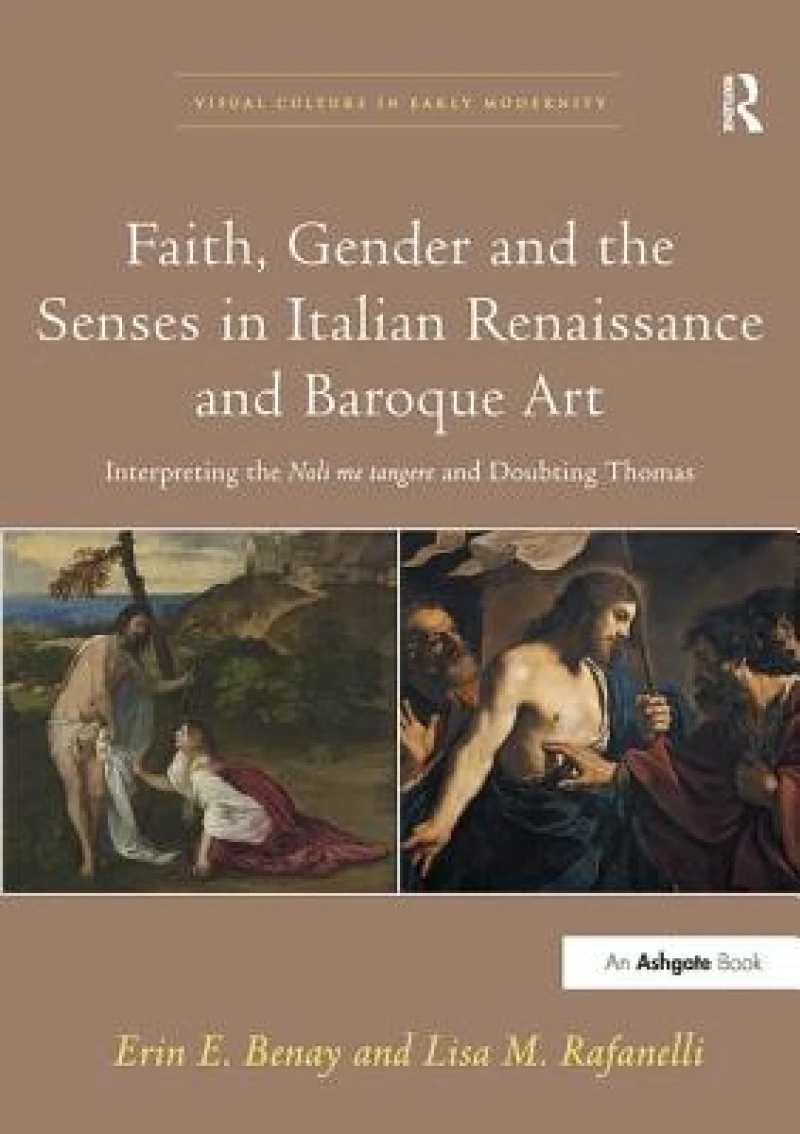
Faith, Gender and the Senses in Italian Renaissance and Baroque Art : Interpreting the Noli me tangere and Doubting Thomas
Book Details
Format
Paperback / Softback
Book Series
Visual Culture in Early Modernity
ISBN-10
1138310255
ISBN-13
9781138310254
Publisher
Taylor & Francis Ltd
Imprint
Routledge
Country of Manufacture
GB
Country of Publication
GB
Publication Date
Jun 14th, 2017
Print length
304 Pages
Weight
596 grams
Dimensions
17.30 x 24.30 x 2.30 cms
Product Classification:
Renaissance artArt & design styles: BaroqueReligious subjects depicted in art
Ksh 10,000.00
Werezi Extended Catalogue
0 in stock
Delivery Location
Delivery fee: Select location
Secure
Quality
Fast
Taking the Noli me tangere and Doubting Thomas episodes as a focal point, this study examines how visual representations of two of the most compelling and related Christian stories engaged with changing devotional and cultural ideals in Renaissance and Baroque Italy. By reuniting their visual examples with important, often little-known textual sources, the authors reveal a complex relationship between visual imagery, the senses, contemporary attitudes toward gender, and the shaping of belief.
Taking the Noli me tangere and Doubting Thomas episodes as a focal point, this study examines how visual representations of two of the most compelling and related Christian stories engaged with changing devotional and cultural ideals in Renaissance and Baroque Italy. This book reconsiders depictions of the ambiguous encounter of Mary Magdalene and Christ in the garden (John 20:11-19, known as the Noli me tangere) and that of Christs post-Resurrection appearance to Thomas (John 20:24-29, the Doubting Thomas) as manifestations of complex theological and art theoretical milieus. By focusing on key artistic monuments of the Italian Renaissance and Baroque periods, the authors demonstrate a relationship between the rise of skeptical philosophy and empirical science, and the efficacy of the senses in the construction of belief. Further, the authors elucidate the differing representational strategies employed by artists to depict touch, and the ways in which these strategies were shaped by gender, social class, and educational level. Indeed, over time St. Thomas became an increasingly public--and therefore masculine--symbol of devotional verification, juridical inquiry, and empirical investigation, while St. Mary Magdalene provided a more private model for pious women, celebrating, mostly behind closed doors, the privileged and active participation of women in the faith. The authors rely on primary source material--paintings, sculptures, religious tracts, hagiography, popular sermons, and new documentary evidence. By reuniting their visual examples with important, often little-known textual sources, the authors reveal a complex relationship between visual imagery, the senses, contemporary attitudes toward gender, and the shaping of belief. Further, they add greater nuance to our understanding of the relationship between popular piety and the visual culture of the period.
Get Faith, Gender and the Senses in Italian Renaissance and Baroque Art by at the best price and quality guaranteed only at Werezi Africa's largest book ecommerce store. The book was published by Taylor & Francis Ltd and it has pages.

