
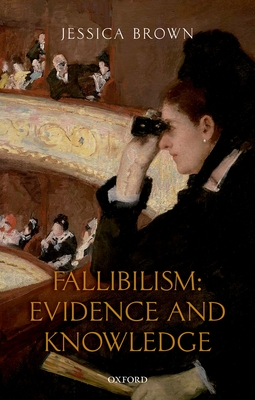
Fallibilism: Evidence and Knowledge
Book Details
Format
Hardback
ISBN-10
0198801777
ISBN-13
9780198801771
Publisher
Oxford University Press
Imprint
Oxford University Press
Country of Manufacture
GB
Country of Publication
GB
Publication Date
Apr 12th, 2018
Print length
210 Pages
Weight
408 grams
Dimensions
14.70 x 22.20 x 2.40 cms
Product Classification:
Philosophy: epistemology & theory of knowledge
KSh 16,250.00
Temporarily out of stock, due soon
0 in stock
Delivery Location
Delivery fee: Select location
Secure
Quality
Fast
Fallibilists claim that one can know a proposition on the basis of evidence that supports it even if the evidence doesn't guarantee its truth. Jessica Brown offers a compelling defence of this view against infallibilists, who claim that it is contradictory to claim to know and yet to admit the possibility of error.
What strength of evidence is required for knowledge? Ordinarily, we often claim to know something on the basis of evidence which doesn''t guarantee its truth. For instance, one might claim to know that one sees a crow on the basis of visual experience even though having that experience does not guarantee that there is a crow (it might be a rook, or one might be dreaming). As a result, those wanting to avoid philosophical scepticism have standardly embraced "fallibilism": one can know a proposition on the basis of evidence that supports it even if the evidence doesn''t guarantee its truth. Despite this, there''s been a persistent temptation to endorse "infallibilism", according to which knowledge requires evidence that guarantees truth. For doesn''t it sound contradictory to simultaneously claim to know and admit the possibility of error? Infallibilism is undergoing a contemporary renaissance. Furthermore, recent infallibilists make the surprising claim that they can avoid scepticism.Jessica Brown presents a fresh examination of the debate between these two positions. She argues that infallibilists can avoid scepticism only at the cost of problematic commitments concerning evidence and evidential support. Further, she argues that alleged objections to fallibilism are not compelling. She concludes that we should be fallibilists. In doing so, she discusses the nature of evidence, evidential support, justification, blamelessness, closure for knowledge, defeat, epistemic akrasia, practical reasoning, concessive knowledge attributions, and the threshold problem.
Get Fallibilism: Evidence and Knowledge by Jessica Brown at the best price and quality guaranteed only at Werezi Africa's largest book ecommerce store. The book was published by Oxford University Press and it has 210 pages.
Customers Who Bought This Also Bought

A Treatise of Human Nature
KSh 2,700.00
Critique of Pure Reason
KSh 3,400.00

Sensuous Knowledge
KSh 4,500.00

Critique of Pure Reason, Abridged
KSh 3,600.00
Sharing Thoughts
KSh 17,000.00

The Critique of Pure Reason
KSh 6,450.00

Critique of Pure Reason
KSh 7,250.00
An Inquiry Into Meaning and Truth
KSh 3,750.00
Intelligence and Spirit
KSh 5,750.00
The Social Construction of What?
KSh 5,200.00

Discourse on Method and Related Writings
KSh 2,000.00

Beyond Good and Evil
KSh 2,000.00

