
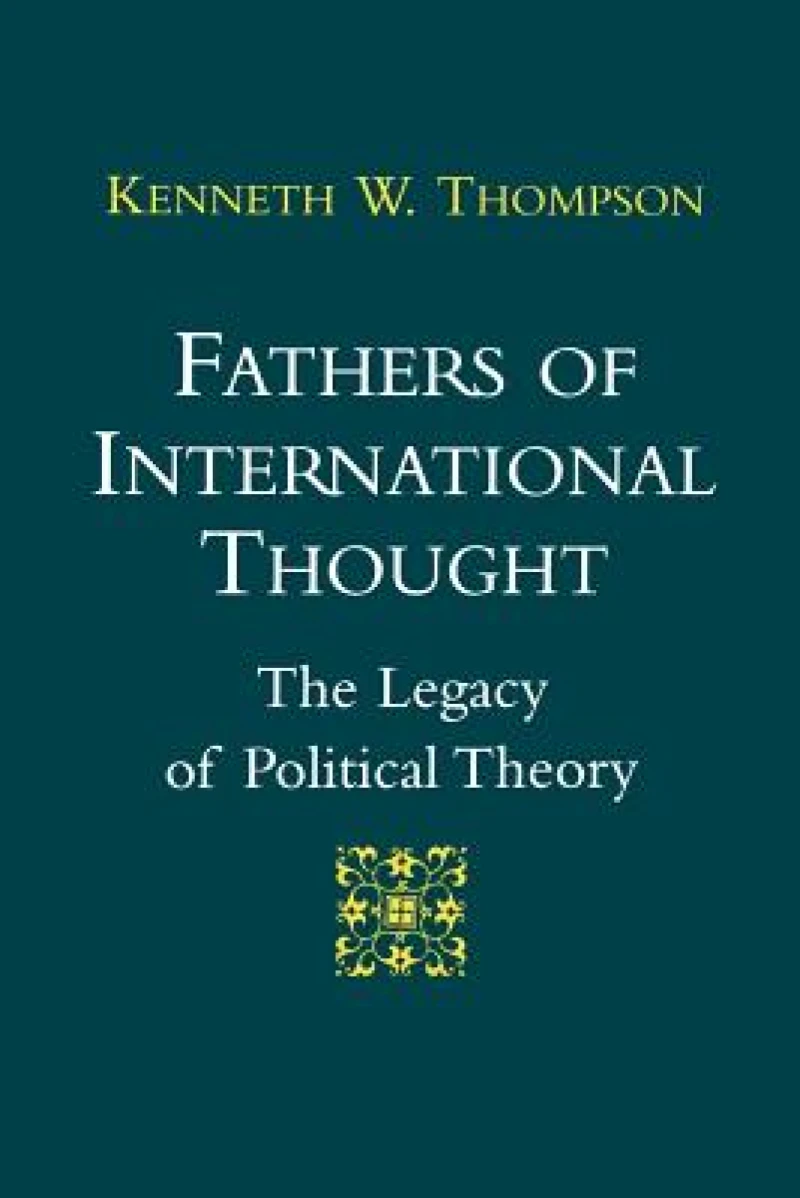
Fathers of International Thought : The Legacy of Political Theory
Book Details
Format
Paperback / Softback
ISBN-10
0807119067
ISBN-13
9780807119068
Publisher
Louisiana State University Press
Imprint
Louisiana State University Press
Country of Manufacture
US
Country of Publication
GB
Publication Date
Mar 1st, 1994
Print length
160 Pages
Weight
249 grams
Dimensions
22.70 x 15.20 x 1.00 cms
Product Classification:
Political science & theoryPolitical science and theoryInternational relations
Ksh 4,500.00
Werezi Extended Catalogue
0 in stock
Delivery Location
Delivery fee: Select location
Secure
Quality
Fast
In Fathers of International Thought, renowned foreign affairs scholar Kenneth W. Thompson returns to the writings of sixteen thinkers in order better to understand the issues and problems that recurrently beset global politics.
In Fathers of International Thought, renowned foreign affairs scholar Kenneth W. Thompson returns to the writings of sixteen thinkers in order better to understand the issues and problems that recurrently beset global politics. A companion volume to Masters of International Thought, in which Thompson analysed the thinking of eighteen leading twentieth-century political theorists, Fathers of International Thought traces the ideas of earlier philosophers, theologians, and legal and political theorists who provided the foundations for the present century's master thinkers.
Thompson begins by discussing the relevance of classical political philosophy to the field of modern international relations theory. He then presents lucid essays on sixteen of the most brilliant minds from Plato through the nineteenth century, focusing on the importance of their thought in contemporary international affairs. Besides Plato, the classical thinkers, whom Thompson refers to as the fathers, include Aristotle, Augustine, Thomas Aquinas, Niccolò Machiavelli, Grotius, David Hume, Jean-Jacques Rousseau, Montesquieu, Edmund Burke, Immanuel Kant, Georg Wilhelm Friedrich Hegel, and Karl Marx.
According to Thompson, the interrelatedness of earlier and recent thought is undeniable for such concepts as authority, justice, community, regimes, and power. He shows how the ideas of the fathers have application to the current international scene, as with events in Eastern Europe and the Persian Gulf area, and political upheaval on the African continent. The lesson for policy makers, students of politics and international relations, and, indeed, all citizens is that a comprehensive philosophical approach to world politics can lead to the rediscovery of enduring political principles and our place in history. By considering the insights of earlier thinkers, decision makers may come to recognise most present-day problems as perennial issues, however changing the context. Understanding the classics may help them avoid unsuccessful patterns in foreign policy.
An introductory survey of early political philosophers and their relevance to our times is sorely needed by students and practitioners of international politics. Fathers of International Thought, by a man Foreign Affairs described as ""one of the best teachers still active from the postwar generation of scholars that developed the discipline of international relations,"" will be of lasting value in meeting that need.
Thompson begins by discussing the relevance of classical political philosophy to the field of modern international relations theory. He then presents lucid essays on sixteen of the most brilliant minds from Plato through the nineteenth century, focusing on the importance of their thought in contemporary international affairs. Besides Plato, the classical thinkers, whom Thompson refers to as the fathers, include Aristotle, Augustine, Thomas Aquinas, Niccolò Machiavelli, Grotius, David Hume, Jean-Jacques Rousseau, Montesquieu, Edmund Burke, Immanuel Kant, Georg Wilhelm Friedrich Hegel, and Karl Marx.
According to Thompson, the interrelatedness of earlier and recent thought is undeniable for such concepts as authority, justice, community, regimes, and power. He shows how the ideas of the fathers have application to the current international scene, as with events in Eastern Europe and the Persian Gulf area, and political upheaval on the African continent. The lesson for policy makers, students of politics and international relations, and, indeed, all citizens is that a comprehensive philosophical approach to world politics can lead to the rediscovery of enduring political principles and our place in history. By considering the insights of earlier thinkers, decision makers may come to recognise most present-day problems as perennial issues, however changing the context. Understanding the classics may help them avoid unsuccessful patterns in foreign policy.
An introductory survey of early political philosophers and their relevance to our times is sorely needed by students and practitioners of international politics. Fathers of International Thought, by a man Foreign Affairs described as ""one of the best teachers still active from the postwar generation of scholars that developed the discipline of international relations,"" will be of lasting value in meeting that need.
Get Fathers of International Thought by at the best price and quality guaranteed only at Werezi Africa's largest book ecommerce store. The book was published by Louisiana State University Press and it has pages.

