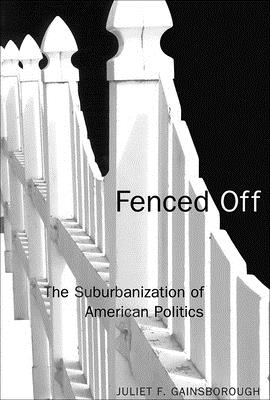
Fenced Off : The Suburbanization of American Politics
Book Details
Format
Paperback / softback
Book Series
American Governance and Public Policy series
ISBN-10
0878408312
ISBN-13
9780878408313
Publisher
Georgetown University Press
Imprint
Georgetown University Press
Country of Manufacture
US
Country of Publication
GB
Publication Date
Mar 2nd, 2001
Print length
200 Pages
Weight
298 grams
Dimensions
15.60 x 23.00 x 1.40 cms
KSh 8,650.00
Currently unavailable
0 in stock
Delivery Location
Delivery fee: Select location
Secure
Quality
Fast
Argues that since the 1980s a distinctive suburban politics has emerged in the United States. This title also argues that the political differences between urban and suburban voters have found expression in changes in congressional representation and new electoral strategies for the major political parties.
Since the 1980s a distinctive suburban politics has emerged in the United States, Juliet F. Gainsborough argues in "Fenced Off". As suburbs have become less economically and socially dependent on the central cities, suburban and urban dwellers have diverged not only in their voting patterns but also in their thinking about national politics. While political reporters have long noted this difference, few quantitative studies have been conducted on suburbanization alone - above and beyond race or class - as a political trend. Using census and public opinion statistics, along with data on congressional districts and party platforms, Gainsborough demonstrates that this "ideology of localism" weakens when suburbs experience city-like problems and strengthens when racial and economic differences with the nearby city increase. In addition, Gainsborough uses national survey data from the 1950s to the 1990s to show that a separate suburban politics has arisen only during the last two decades. Further, she argues, the political differences between urban and suburban voters have found expression in changes in congressional representation and new electoral strategies for the major political parties. As Congressional districts become increasingly suburban, "soccer moms" and liveability agendas come to dominate party platforms, and the needs of the urban poor disappear from political debate. "Fenced Off" uses the tools of political science to prove what political commentators have sensed - that the suburbs offer a powerful voting bloc that is being courted with sophisticated new strategies.
Get Fenced Off by Juliet F. Gainsborough at the best price and quality guaranteed only at Werezi Africa's largest book ecommerce store. The book was published by Georgetown University Press and it has 200 pages.
Customers Who Bought This Also Bought

Bad Blood
KSh 2,000.00

So You''ve Been Publicly Shamed
KSh 2,000.00

The Near East since the First World War
KSh 11,400.00
Blind No More
KSh 9,600.00

Equiano, the African
KSh 4,150.00

Complexion of Empire in Natchez
KSh 13,550.00

Where There Are Mountains
KSh 6,300.00

Slavery and the University – Histories and Legacies
KSh 19,850.00

Remembering Enslavement
KSh 7,900.00
Blue Coat or Powdered Wig
KSh 18,000.00

To Live an Antislavery Life – Personal Politics and the Antebellum Black Middle Class
KSh 14,700.00
Treme
KSh 4,950.00