
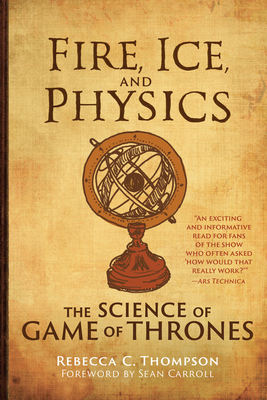
Fire, Ice, and Physics
Book Details
Format
Paperback / softback
ISBN-10
0262539616
ISBN-13
9780262539616
Publisher
MIT Press Ltd
Imprint
MIT Press
Country of Manufacture
GB
Country of Publication
GB
Publication Date
Nov 10th, 2020
Print length
296 Pages
Weight
426 grams
Dimensions
14.10 x 22.10 x 2.50 cms
Product Classification:
Science: general issues
KSh 3,050.00
Werezi Extended Catalogue
Delivery in 12 days
1 copies in stock
Delivery Location
Delivery fee: Select location
Delivery in 12 days
Secure
Quality
Fast
Exploring the science in George R. R. Martin’s fantastical world, from the physics of an ice wall to the genetics of the Targaryens and Lannisters
Game of Thrones is a fantasy that features a lot of made-up science—fabricated climatology (when is winter coming?), astronomy, metallurgy, chemistry, and biology. Most fans of George R. R. Martin’s fantastical world accept it all as part of the magic. A trained scientist, watching the fake science in Game of Thrones, might think, “But how would it work?” In Fire, Ice, and Physics, Rebecca Thompson turns a scientist’s eye on Game of Thrones, exploring, among other things, the science of an ice wall, the genetics of the Targaryen and Lannister families, and the biology of beheading. Thompson, a PhD in physics and an enthusiastic Game of Thrones fan, uses the fantasy science of the show as a gateway to some interesting real science, introducing GOT fandom to a new dimension of appreciation.
Thompson starts at the beginning, with winter, explaining seasons and the very elliptical orbit of the Earth that might cause winter to come (or not come). She tells us that ice can behave like ketchup, compares regular steel to Valyrian steel, explains that dragons are “bats, but with fire,” and considers Targaryen inbreeding. Finally she offers scientific explanations of the various types of fatal justice meted out, including beheading, hanging, poisoning (reporting that the effects of “the Strangler,” administered to Joffrey at the Purple Wedding, resemble the effects of strychnine), skull crushing, and burning at the stake.
Even the most faithful Game of Thrones fans will learn new and interesting things about the show from Thompson’s entertaining and engaging account. Fire, Ice, and Physics is an essential companion for all future bingeing.
Game of Thrones is a fantasy that features a lot of made-up science—fabricated climatology (when is winter coming?), astronomy, metallurgy, chemistry, and biology. Most fans of George R. R. Martin’s fantastical world accept it all as part of the magic. A trained scientist, watching the fake science in Game of Thrones, might think, “But how would it work?” In Fire, Ice, and Physics, Rebecca Thompson turns a scientist’s eye on Game of Thrones, exploring, among other things, the science of an ice wall, the genetics of the Targaryen and Lannister families, and the biology of beheading. Thompson, a PhD in physics and an enthusiastic Game of Thrones fan, uses the fantasy science of the show as a gateway to some interesting real science, introducing GOT fandom to a new dimension of appreciation.
Thompson starts at the beginning, with winter, explaining seasons and the very elliptical orbit of the Earth that might cause winter to come (or not come). She tells us that ice can behave like ketchup, compares regular steel to Valyrian steel, explains that dragons are “bats, but with fire,” and considers Targaryen inbreeding. Finally she offers scientific explanations of the various types of fatal justice meted out, including beheading, hanging, poisoning (reporting that the effects of “the Strangler,” administered to Joffrey at the Purple Wedding, resemble the effects of strychnine), skull crushing, and burning at the stake.
Even the most faithful Game of Thrones fans will learn new and interesting things about the show from Thompson’s entertaining and engaging account. Fire, Ice, and Physics is an essential companion for all future bingeing.
Get Fire, Ice, and Physics by Rebecca C. Thompson at the best price and quality guaranteed only at Werezi Africa's largest book ecommerce store. The book was published by MIT Press Ltd and it has 296 pages.
Customers Who Bought This Also Bought

Dreaming Reality – How Neuroscience and Mysticism Can Unlock the Secrets of Consciousness
KSh 4,500.00

Structures
KSh 2,700.00

Dry-fly Fishing In Theory And Practice
KSh 5,500.00

Character of Physical Law
KSh 2,350.00
Sell Your Research
KSh 5,400.00

Charles Darwin
KSh 7,100.00

Discovering the Desert
KSh 4,150.00

Galileo''s Commandment
KSh 4,850.00

Magnetoresponsive Soft Nanosystems
KSh 39,400.00

A Many-colored Glass
KSh 2,700.00

Fire and Stone
KSh 5,550.00

Arthur Pullinger: an Early Traveler in Syria and Asia Minor
KSh 6,300.00
