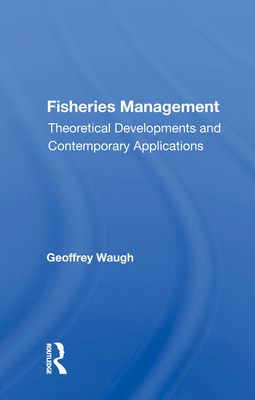
Fisheries Management : Theoretical Developments and Contemporary Applications
Book Details
Format
Hardback
ISBN-10
0367020408
ISBN-13
9780367020408
Publisher
Taylor & Francis Ltd
Imprint
Routledge
Country of Manufacture
GB
Country of Publication
GB
Publication Date
Jun 7th, 2019
Print length
272 Pages
Weight
660 grams
Product Classification:
Politics & governmentPolitics and government
KSh 30,950.00
Currently unavailable
0 in stock
Delivery Location
Delivery fee: Select location
Secure
Quality
Fast
Among the problems of the modern fisheries industry is the persistent trend toward the severe depletion of fish stocks, resulting in low catch rates and poor economic returns, along with unnecessary accumulations of capital investments. Dr. Waugh argues that these problems call for effective management procedures based on bioeconomic modelling, which integrates the population dynamics of fish resources with the economic processes of harvesting and marketing. Assessing developments in bioeconomic theory, Dr. Waugh discusses why recent advances have not been fully translated into improvements in the management of marine fisheries. He cites the difficulties of reaching a consensus concerning suitable objectives for fisheries management, as well as the problems of designing a regulatory framework to improve the operation of the industry. To illustrate the utility of bioeconomic modelling, Dr. Waugh presents case studies of two Australian fisheries. A dynamic, stochastic, numeric model is developed for the Exmouth Gulf Prawn Fishery to provide insights into the optimal exploitation of a yearly resource, where fluctuations in recruitment, natural mortality, and catchability are important. The study of the New South Wales Abalone Fishery highlights the difficulties of obtaining the necessary overview of a fishery and the problems in collecting the data required for modelling and management.
Get Fisheries Management by Geoffrey Waugh at the best price and quality guaranteed only at Werezi Africa's largest book ecommerce store. The book was published by Taylor & Francis Ltd and it has 272 pages.
Customers Who Bought This Also Bought

Regime Change
KSh 5,050.00

Art of War / The Book of Lord Shang
KSh 1,100.00

Wretched of the Earth
KSh 2,000.00

White Saviorism In International Development
KSh 3,800.00
How To Do Nothing
KSh 2,700.00

How Civil Wars Start
KSh 2,000.00

Tomorrow Is Yesterday
KSh 4,700.00

The Thinking Machine
KSh 2,350.00

Second Treatise of Government – Norton Library
KSh 1,600.00

Becoming
KSh 2,350.00

A River in Darkness
KSh 1,250.00

Warning to the West
KSh 1,600.00