
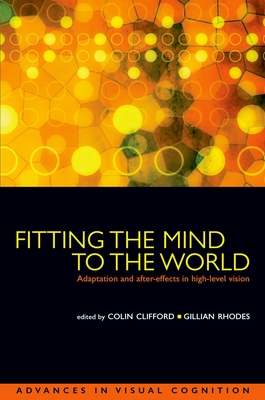
Fitting the Mind to the World : Adaptation and After-Effects in High-Level Vision
Book Details
Format
Hardback
Book Series
Advances in Visual Cognition
ISBN-10
0198529694
ISBN-13
9780198529699
Publisher
Oxford University Press
Imprint
Oxford University Press
Country of Manufacture
GB
Country of Publication
GB
Publication Date
May 5th, 2005
Print length
384 Pages
Weight
748 grams
Dimensions
24.40 x 16.40 x 2.70 cms
KSh 23,900.00
Currently unavailable
0 in stock
Delivery Location
Delivery fee: Select location
Secure
Quality
Fast
Explores the brain's remarkable capacity to adapt to its current visual environment. This work describes how visual experience alters the adult brain, fitting the mind to the world, and ensuring the efficient coding of sensory signals. It demonstrates how this plasticity affects every aspect of our visual experience.
Adaptation phenomena provide striking examples of perceptual plasticity and offer valuable insight into the mechanisms of visual coding. The technique of psychophysical adaptation has aptly been termed the psychologist''s microelectrode because of its usefulness in investigating the coding of sensory information in the human brain. Its broader relevance though is illustrated by the increasing use of adaptation to study more cognitive aspects of vision such as the mechanisms of face perception and the neural substrates of visual awareness.This book brings together a collection of studies from international researchers, which demonstrate the brain''s remarkable capacity to adapt its representation of the visual world in response to changes in its environment. A major theme throughout is that adaptation at all stages of visual processing serves a functional role in the efficient representation of the prevailing visual environment. Information about the visual world is coded in the rate at which neurons fire. However, neurons can only respond over a certain range of firing rates. Adaptation of the way in which neurons code visual information tends to make optimal use of this limited response range. Though these principles are well established at the level of light adaptation in the retina, it is only relatively recently that researchers have started to look for analogous behaviour at the higher levels of the visual system. This book is the first to bring together evidence that adaptation in high-level vision, as at the lower levels, serves to fit the mind to the world.
Get Fitting the Mind to the World by Colin W. G. Clifford at the best price and quality guaranteed only at Werezi Africa's largest book ecommerce store. The book was published by Oxford University Press and it has 384 pages.
Customers Who Bought This Also Bought

The Origins of Object Knowledge
KSh 15,950.00

APA Handbook of Behavior Analysis
KSh 60,650.00

A Datafied Mind
KSh 5,800.00

Industrial Neuroscience in Aviation
KSh 19,800.00

Kognitive Neurowissenschaften
KSh 14,750.00

Researching Daily Life
KSh 8,100.00

Choice, Decision, and Measurement
KSh 9,000.00

Animal Behaviour
KSh 13,500.00

The Neuropsychopathology of Schizophrenia
KSh 27,000.00

Cognitive Psychology
KSh 13,500.00

Invisible Gorilla
KSh 2,000.00
Contextual Cognition
KSh 9,000.00
