
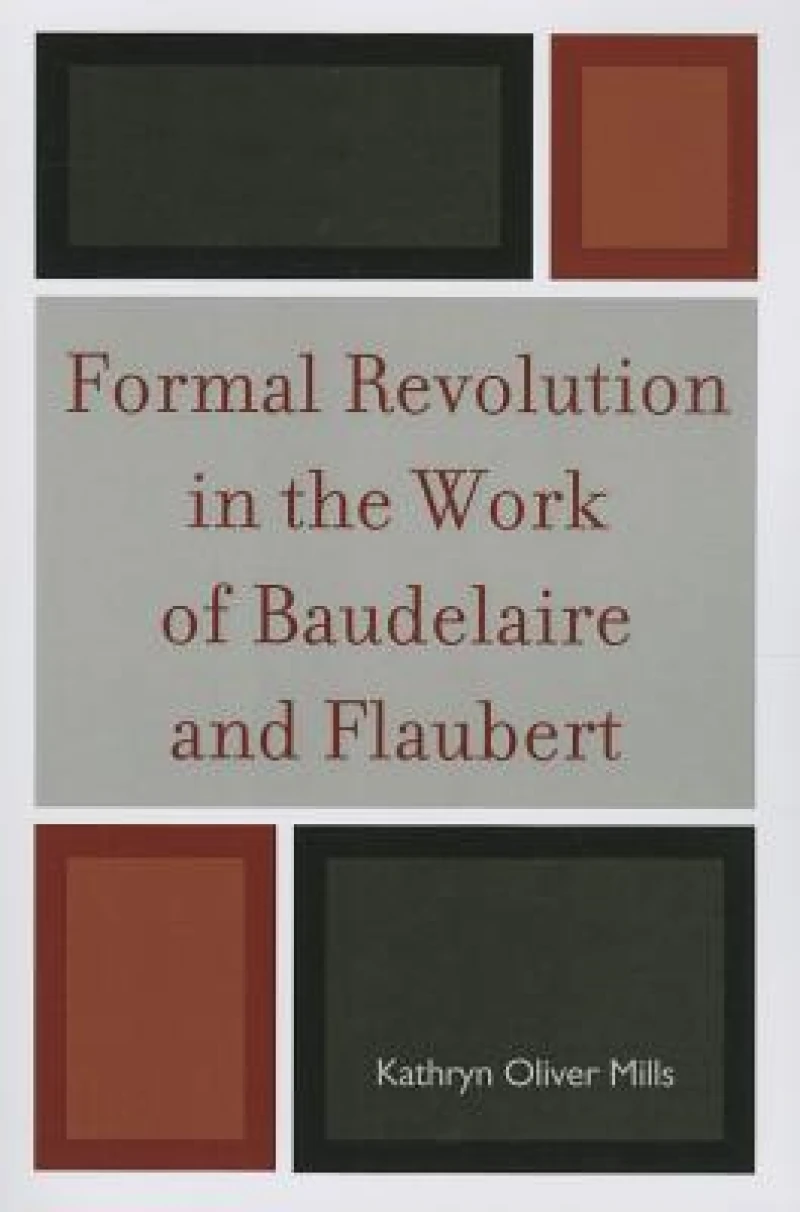
Formal Revolution in the Work of Baudelaire and Flaubert
Book Details
Format
Paperback / Softback
ISBN-10
1611494923
ISBN-13
9781611494921
Publisher
Bloomsbury Publishing Plc
Imprint
University of Delaware Press
Country of Manufacture
GB
Country of Publication
GB
Publication Date
Oct 17th, 2013
Print length
200 Pages
Weight
294 grams
Dimensions
22.60 x 15.10 x 1.70 cms
Product Classification:
Literary studies: generalLiterary studies: poetry & poets
Ksh 8,800.00
Manufactured on Demand
Delivery in 29 days
Delivery Location
Delivery fee: Select location
Delivery in 29 days
Secure
Quality
Fast
In Formal Revolution in the Work of Baudelaire and Flaubert, Kathryn Oliver Mills argues that despite the enduring celebrity of Baudelaire and Flaubert, their significance to modern art has been miscast and misunderstood. To date, literary criticism has paid insufficient attention to these authors' literary form and their socio-cultural context. In addition, critical literature has not always adequately integrated individual works to each author’s broader oeuvre: on the one hand critics do not often maintain rigorous distinctions among texts when discussing Baudelaire and Flaubert, and on the other hand scholars of Baudelaire and Flaubert have not consistently considered the relationship of individual texts to either writer’s corpus. Furthermore, critical focus has been on the modernity of Les Fleurs du mal, Madame Bovary, and L'Education Sentimentale. Addressing these lacunae in scholarship, Mills puts forth the argument that Baudelaire's collection of prose poems, Le Spleen de Paris, and Flaubert's short, poetic tales, Trois contes, best embody the modern aesthetic that Baudelaire develops in Le Peintre de la vie moderne and that Flaubert elaborates in his correspondence. Formal Revolution places these relatively less well-known but last published works in relationship with the artistic goals of their authors, showing that Baudelaire and Flaubert were both acutely aware of the need to launch a new form of literature in order to literally “come to terms with” the dramatic changes transforming the nineteenth-century into the Modern Age. More specifically, Formal Revolution demonstrates that for Baudelaire and Flaubert the formal project of fusing prose with poetry—as poetic prose in the case of Flaubert, as poetry in prose in the case of Baudelaire—was crucial to their mission of “painting modern life.” This work concludes that experimentation with literary form represents these two seminal writers’ major legacy to modernity; suggests that the twentieth-century might have gone too far down that road; and speculates about the future direction of literature. The modernity of Baudelaire and Flaubert, still relevant today but often taken for granted, needs to be reexamined in light of the cultural, formal, and contextual considerations that inform Formal Revolution in the Work of Baudelaire and Flaubert.
In Formal Revolution in the Work of Baudelaire and Flaubert, Kathryn Oliver Mills argues that despite the enduring celebrity of Baudelaire and Flaubert, their significance to modern art has been miscast and misunderstood. To date, literary criticism has paid insufficient attention to these authors'' literary form and their socio-cultural context. In addition, critical literature has not always adequately integrated individual works to each author’s broader oeuvre: on the one hand critics do not often maintain rigorous distinctions among texts when discussing Baudelaire and Flaubert, and on the other hand scholars of Baudelaire and Flaubert have not consistently considered the relationship of individual texts to either writer’s corpus. Furthermore, critical focus has been on the modernity of Les Fleurs du mal, Madame Bovary, and L''Education Sentimentale. Addressing these lacunae in scholarship, Mills puts forth the argument that Baudelaire''s collection of prose poems, Le Spleen de Paris, and Flaubert''s short, poetic tales, Trois contes, best embody the modern aesthetic that Baudelaire develops in Le Peintre de la vie moderne and that Flaubert elaborates in his correspondence. Formal Revolution places these relatively less well-known but last published works in relationship with the artistic goals of their authors, showing that Baudelaire and Flaubert were both acutely aware of the need to launch a new form of literature in order to literally “come to terms with” the dramatic changes transforming the nineteenth-century into the Modern Age. More specifically, Formal Revolution demonstrates that for Baudelaire and Flaubert the formal project of fusing prose with poetry—as poetic prose in the case of Flaubert, as poetry in prose in the case of Baudelaire—was crucial to their mission of “painting modern life.” This work concludes that experimentation with literary form represents these two seminal writers’ major legacy to modernity; suggests that the twentieth-century might have gone too far down that road; and speculates about the future direction of literature. The modernity of Baudelaire and Flaubert, still relevant today but often taken for granted, needs to be reexamined in light of the cultural, formal, and contextual considerations that inform Formal Revolution in the Work of Baudelaire and Flaubert.
Get Formal Revolution in the Work of Baudelaire and Flaubert by at the best price and quality guaranteed only at Werezi Africa's largest book ecommerce store. The book was published by Bloomsbury Publishing Plc and it has pages.

