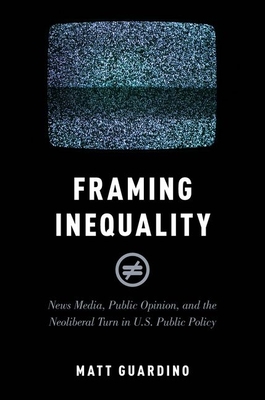
Framing Inequality : News Media, Public Opinion, and the Neoliberal Turn in U.S. Public Policy
Book Details
Format
Paperback / softback
ISBN-10
0190888199
ISBN-13
9780190888190
Publisher
Oxford University Press Inc
Imprint
Oxford University Press Inc
Country of Manufacture
US
Country of Publication
GB
Publication Date
Apr 11th, 2019
Print length
328 Pages
Weight
438 grams
Dimensions
15.50 x 23.40 x 2.60 cms
Product Classification:
Public administrationPolitical economyPress & journalism
KSh 6,650.00
Currently unavailable
0 in stock
Delivery Location
Delivery fee: Select location
Secure
Quality
Fast
This book argues that political-economic features of the U.S. commercial media system have generated news coverage that favors neoliberal viewpoints during pivotal domestic policy debates since the early 1980s. It also demonstrates that this coverage can shape public opinion to support policies that exacerbate economic and political inequality.
Neoliberal policy approaches have swept over the American political economy in recent decades. In Framing Inequality, Matt Guardino focuses on the power of corporate news media in shaping how the public understands the pivotal policy debates of this period. Drawing on a wide range of empirical evidence from the dawn of the Reagan era into the Trump administration, he explains how profit pressures and commercial imperatives in the media have narrowed and trivialized news coverage and influenced public attitudes in the process. Guardino highlights how the political-economic structure of mainstream media operates to magnify some political messages and to mute or shut out others. He contends that news framing of policies that contribute to economic inequality has been unequal, and that this has undermined Americans'' opportunities to express their views on an equal basis. Framing Inequality is a unique study that offers critical understanding of not only how neoliberalism succeeded as a political project, but also how Americans might begin to build a more democratic and egalitarian media system.
Get Framing Inequality by Matt Guardino at the best price and quality guaranteed only at Werezi Africa's largest book ecommerce store. The book was published by Oxford University Press Inc and it has 328 pages.
Customers Who Bought This Also Bought

American Beast
KSh 2,700.00

In Defense of Politics in Public Administration
KSh 3,450.00

The New Global Economic Order
KSh 7,200.00

The Brexit Effect, 2016–2026
KSh 3,050.00

The Moynihan Report Revisited:
KSh 12,100.00

Building Service-Oriented Government
KSh 5,050.00

The Moynihan Report Revisited:
KSh 12,050.00

Saving the Georgia Coast
KSh 4,650.00

Migration Crises and the Structure of International Cooperation
KSh 17,000.00

Keeping the Chattahoochee
KSh 5,500.00

Night Rules
KSh 30,950.00

Partners in Gatekeeping
KSh 26,700.00