
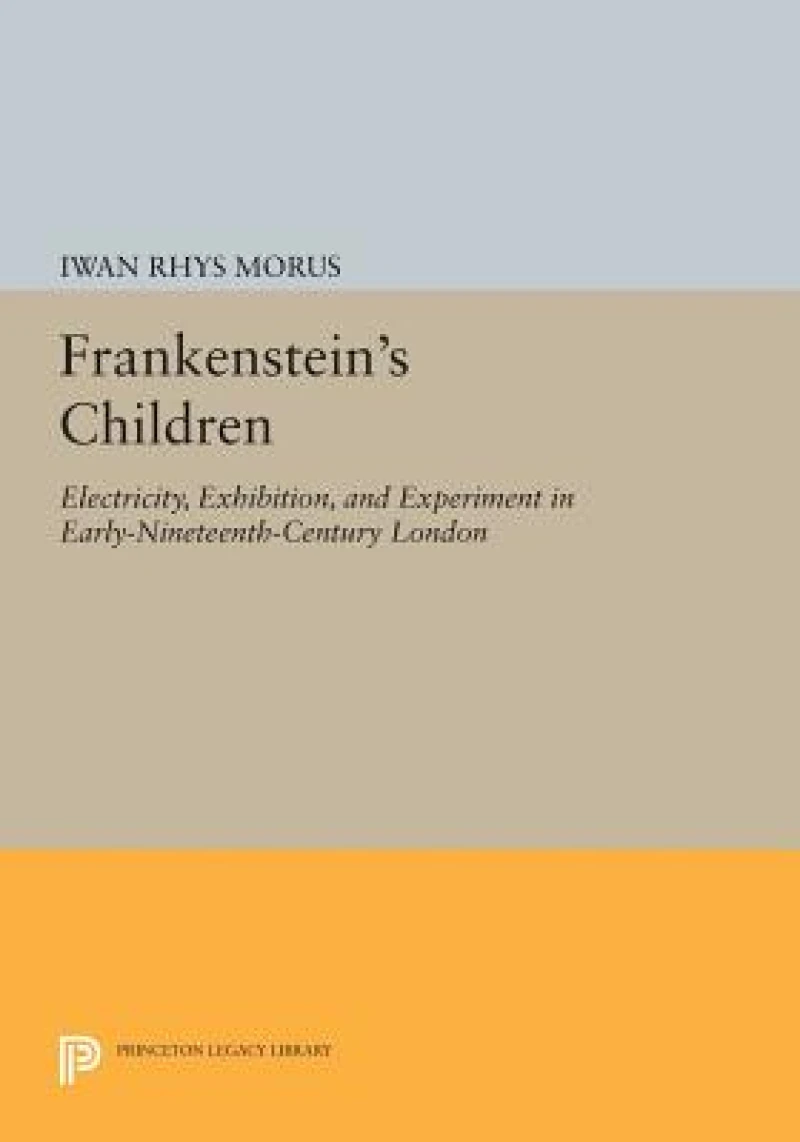
Frankenstein`s Children – Electricity, Exhibition, and Experiment in Early–Nineteenth–Century London : Electricity, Exhibition, and Experiment in Early-Nineteenth-Century London
Book Details
Format
Paperback / Softback
Book Series
Princeton Legacy Library
ISBN-10
0691605270
ISBN-13
9780691605272
Publisher
Princeton University Press
Imprint
Princeton University Press
Country of Manufacture
US
Country of Publication
GB
Publication Date
Jul 14th, 2014
Print length
340 Pages
Weight
656 grams
Dimensions
17.70 x 25.60 x 2.20 cms
Product Classification:
British & Irish historyEuropean historyHistory of science
Ksh 12,250.00
Werezi Extended Catalogue
0 in stock
Delivery Location
Delivery fee: Select location
Secure
Quality
Fast
During the second quarter of the nineteenth century, Londoners were enthralled by a strange fluid called electricity. In examining this period, Iwan Morus moves beyond the conventional focus on the celebrated Michael Faraday to discuss other electrical experimenters, who aspired to spectacular public displays of their discoveries. Revealing connect
During the second quarter of the nineteenth century, Londoners were enthralled by a strange fluid called electricity. In examining this period, Iwan Morus moves beyond the conventional focus on the celebrated Michael Faraday to discuss other electrical experimenters, who aspired to spectacular public displays of their discoveries. Revealing connections among such diverse fields as scientific lecturing, laboratory research, telegraphic communication, industrial electroplating, patent conventions, and innovative medical therapies, Morus also shows how electrical culture was integrated into a new machine-dominated, consumer society. He sees the history of science as part of the history of production, and emphasizes the labor and material resources needed to make electricity work. Frankenstein's Children explains that Faraday, with his colleagues at the Royal Society and the Royal Institution, looked at science as the province of a highly trained elite, who presented their abstract picture of nature only to select groups. The book contrasts Faraday's views with those of other practitioners, to whom science was a practical, skill-based activity open to all. In venues such as the Galleries of Practical Science, electrical phenomena were presented to a public less distinguished but no less enthusiastic and curious than Faraday's audiences. William Sturgeon, for instance, emphasized building apparatus and exhibiting electrical phenomena, while chemists, instrument-makers, and popular lecturers supported the London Electrical Society. These previously little studied "electricians" contributed much to the birth of "Frankenstein's children"--the not completely benign effects of electricity on a new consumer world. Originally published in 1998. The Princeton Legacy Library uses the latest print-on-demand technology to again make available previously out-of-print books from the distinguished backlist of Princeton University Press. These editions preserve the original texts of these important books while presenting them in durable paperback and hardcover editions. The goal of the Princeton Legacy Library is to vastly increase access to the rich scholarly heritage found in the thousands of books published by Princeton University Press since its founding in 1905.
Get Frankenstein`s Children – Electricity, Exhibition, and Experiment in Early–Nineteenth–Century London by at the best price and quality guaranteed only at Werezi Africa's largest book ecommerce store. The book was published by Princeton University Press and it has pages.

