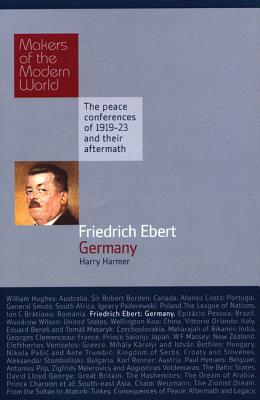
Friedrich Ebert: Germany : The Peace Conferences of 1919-23 and Their Aftermath
by
Harry Harmer
Book Details
Format
Hardback
Book Series
Makers of the Modern World
ISBN-10
1905791631
ISBN-13
9781905791637
Publisher
Haus Publishing
Imprint
Haus Publishing
Country of Manufacture
GB
Country of Publication
GB
Publication Date
Nov 1st, 2008
Print length
208 Pages
Weight
404 grams
Dimensions
20.90 x 14.10 x 2.10 cms
KSh 2,350.00
Re-Printing
0 in stock
Delivery Location
Delivery fee: Select location
Secure
Quality
Fast
Friedrich Ebert (1871-1925) was influential in securing SPD support for the war in 1914. He reluctantly accepted the need for Germany to sign the Treaty of Versailles, at one point saying he might be prepared to resume the war. This book examines how much of a part treaty played in creating the circumstances of the Second World War.
This title is about Friedrich Ebert (1871-1925). Ebert was influential in securing SPD support for the war in 1914. On the eve of war he travelled to Switzerland to arrange the movement of SPD funds if the party was outlawed. As the leader of organized labour, Ebert had close relations with government and military authorities throughout the war. Two of his sons were killed during the war, something he used to emphasise his patriotism. On 9 November, 1918, Ebert became Imperial Chancellor as revolution broke out in Berlin. He opposed the radical left, declaring, 'Without democracy there is no freedom. Violence, no matter who is using it, is always reactionary', but he compromised Weimar democracy by his dependence on the army command and his use of the para-military Freikorps against the left.Ebert headed a joint SPD-USPD government until elections were held to a National Constituent Assembly in January 1919. Ebert became president of the new Weimar Republic (Germany's first democratically elected head of state) and retained office in a turbulent period in German politics. Ebert reluctantly accepted the need for Germany to sign the Treaty of Versailles, at one point saying he might be prepared to resume the war. It was left to Johannes Bell (depicted by Sir William Orpen from behind) and Hermann Muller (shown leaning over him) to sign on behalf of Germany. There were arguments among the Allies over how Germany should be treated, as France, Britain and the United States prioritised different objectives.In May 1919, the terms of the Treaty - on reparations, war guilt clause, loss of territories in Europe and colonies, limitations on armed forces - were presented to German representatives, precipitating opposition in government and the Armed Forces, and heated discussion in Cabinet. He continued as President until 1925, forced to confront the issues that arose from the Treaty and its political and economic consequences. After his death came the unravelling of the Treaty and the book examines how much of a part it played in creating the circumstances of the Second World War.
Get Friedrich Ebert: Germany by Harry Harmer at the best price and quality guaranteed only at Werezi Africa's largest book ecommerce store. The book was published by Haus Publishing and it has 208 pages.
Customers Who Bought This Also Bought

The Second Emancipation – Nkrumah, Pan–Africanism, and Global Blackness at High Tide
KSh 5,650.00

Churchill
KSh 3,700.00

Spy and the Traitor
KSh 2,150.00
King
KSh 2,700.00
American Prometheus
KSh 2,700.00

Gandhi 1914-1948
KSh 3,950.00

Warmth of Other Suns
KSh 3,050.00
Frederick Douglass
KSh 3,350.00
Lumumba
KSh 2,350.00

Kierkegaard
KSh 1,800.00
Only Plane in the Sky
KSh 2,700.00

History
KSh 9,000.00