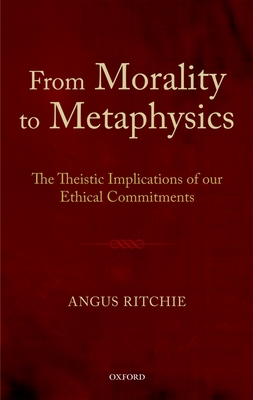
From Morality to Metaphysics : The Theistic Implications of our Ethical Commitments
Book Details
Format
Hardback
ISBN-10
0199652511
ISBN-13
9780199652518
Publisher
Oxford University Press
Imprint
Oxford University Press
Country of Manufacture
GB
Country of Publication
GB
Publication Date
Nov 22nd, 2012
Print length
208 Pages
Weight
386 grams
Dimensions
22.20 x 14.70 x 1.70 cms
KSh 15,700.00
Currently unavailable
0 in stock
Delivery Location
Delivery fee: Select location
Secure
Quality
Fast
Angus Ritchie offers an argument for the existence of God, which is based on our most fundamental moral beliefs. He argues for the 'deliberative indispensability' of moral realism, and asserts that only theism can adequately explain our capacity for knowledge of objective moral truths.
From Morality to Metaphysics offers an argument for the existence of God, based on our most fundamental moral beliefs. Angus Ritchie engages with a range of the most significant secular moral philosophers of our time, and argues that they all face a common difficulty which only theism can overcome. The book begins with a defence of the ''deliberative indispensability'' of moral realism, arguing that the practical deliberation human beings engage in on a daily basis only makes sense if they take themselves to be aiming at an objective truth. Furthermore, when humans engage in practical deliberation, they necessarily take their processes of reasoning to have some ability to track the truth. Ritchie''s central argument builds on this claim, to assert that only theism can adequately explain our capacity for knowledge of objective moral truths. He demonstrates that we need an explanation as well as a justification of these cognitive capacities. Evolutionary biology is not able to generate the kind of explanation which is required--and, in consequence, all secular philosophical accounts are forced either to abandon moral objectivism or to render the human capacity for moral knowledge inexplicable. This case is illustrated with discussions of a wide range of moral philosophers including Simon Blackburn, Thomas Scanlon, Philippa Foot, and John McDowell.Ritchie concludes by arguing that only purposive accounts of the universe (such as theism and Platonism) can account for human moral knowledge. Among such purposive accounts, From Morality to Metaphysics makes the case for theism as the most satisfying, intelligible explanation of our cognitive capacities.
Get From Morality to Metaphysics by Angus Ritchie at the best price and quality guaranteed only at Werezi Africa's largest book ecommerce store. The book was published by Oxford University Press and it has 208 pages.
Customers Who Bought This Also Bought
Xmeditations
KSh 700.00
Groundwork for the Metaphysics of Morals
KSh 2,000.00

On the Genealogy of Morals
KSh 2,000.00
Beyond Good and Evil
KSh 2,000.00
The Nicomachean Ethics
KSh 1,600.00

The Sovereignty of Good
KSh 5,400.00

Justice
KSh 2,000.00
Meditations
KSh 1,600.00
What We Owe The Future
KSh 2,000.00

The Analects
KSh 2,350.00

How to Be a Leader – An Ancient Guide to Wise Leadership
KSh 2,800.00

There Are Places in the World Where Rules Are Less Important Than Kindness
KSh 3,600.00