
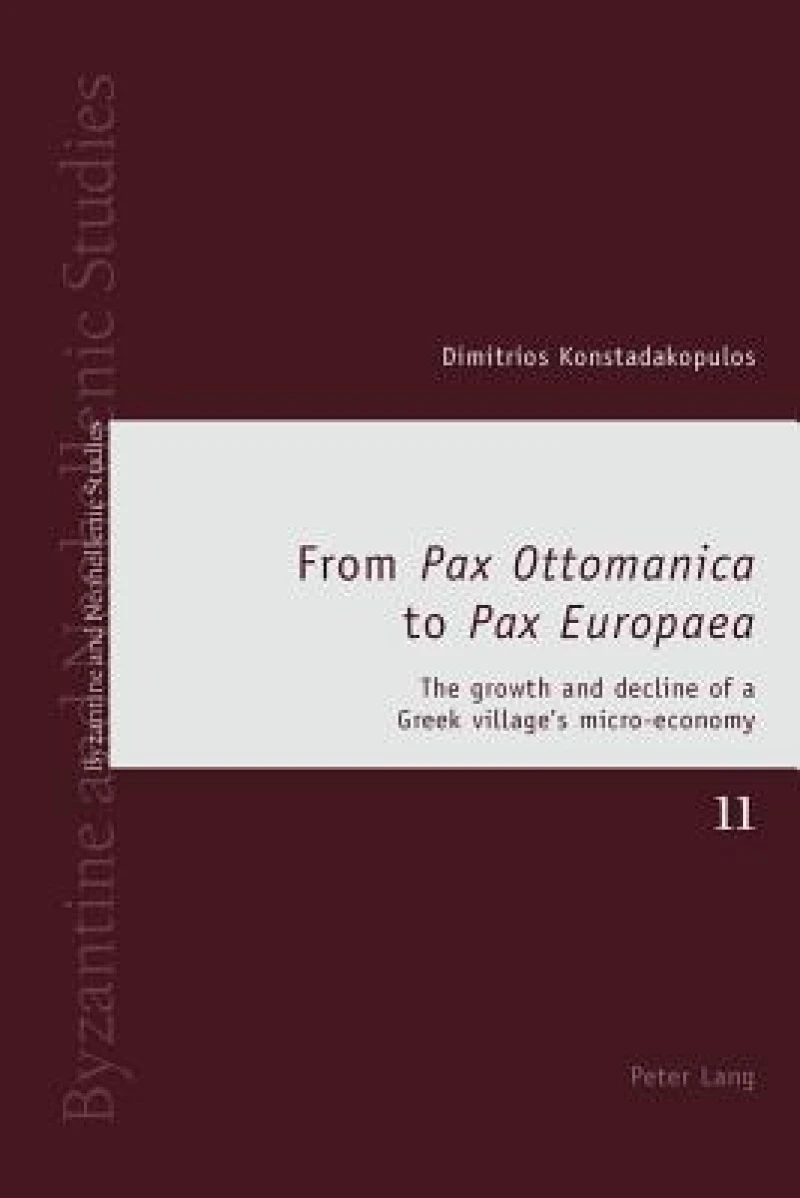
From «Pax Ottomanica» to «Pax Europaea» : The growth and decline of a Greek village’s micro-economy
New
Book Details
Format
Paperback / Softback
Book Series
Byzantine and Neohellenic Studies
ISBN-10
3034317492
ISBN-13
9783034317498
Edition
New
Publisher
Peter Lang AG, Internationaler Verlag der Wissenschaften
Imprint
Peter Lang AG, Internationaler Verlag der Wissensc
Country of Manufacture
CH
Country of Publication
GB
Publication Date
Jan 14th, 2014
Print length
359 Pages
Weight
530 grams
Dimensions
22.60 x 15.00 x 2.40 cms
Ksh 12,800.00
Manufactured on Demand
0 in stock
Delivery Location
Delivery fee: Select location
Secure
Quality
Fast
The rationale of this book is to employ a comprehensive micro-history of one particular community, the village of Tsamantas, in north-western Greece, as a means of providing a detailed picture that will permit extrapolation to a wider context. The author draws upon books, archived materials, and illuminating oral accounts of local events.
The macroeconomic development of south-eastern Europe has been profoundly affected not only by the region’s major historical events – for example, liberation from the Ottoman Empire, the outbreak of civil wars, and the birth of new nations – but also by global events, such as the world-wide conflicts of the twentieth century, and the recent transnational processes of globalisation and European integration. The rationale of this book is to employ a comprehensive micro-history – that is, the history of one particular community: in this case, the village of Tsamantas, in north-western Greece – as a means of providing a detailed picture that will permit extrapolation to a wider context. Situated in one of the most isolated parts of the region of Epirus, Tsamantas has a complex history and a rich folk culture. At times, it has been a textbook example of how decision-making within a community can impact upon the success of the local economy. Its inhabitants have been rational problem-solvers, with a sense of what is in their family’s best interests, rather than passive victims of circumstance, and their choices at critical points in the village’s history have resulted either in growth or decline. The author focuses his groundbreaking analysis on these choices, drawing upon publications, archived materials, and illuminating oral accounts of local events.
Get From «Pax Ottomanica» to «Pax Europaea» by at the best price and quality guaranteed only at Werezi Africa's largest book ecommerce store. The book was published by Peter Lang AG, Internationaler Verlag der Wissenschaften and it has pages.

