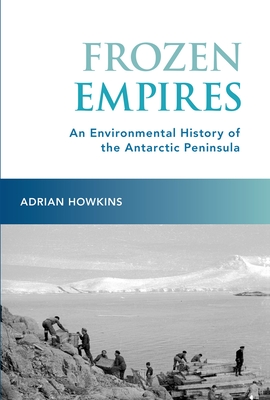
Frozen Empires : An Environmental History of the Antarctic Peninsula
Book Details
Format
Hardback
ISBN-10
0190249145
ISBN-13
9780190249144
Publisher
Oxford University Press Inc
Imprint
Oxford University Press Inc
Country of Manufacture
US
Country of Publication
GB
Publication Date
Jan 5th, 2017
Print length
302 Pages
Weight
552 grams
Dimensions
16.50 x 24.20 x 3.00 cms
KSh 9,000.00
Currently unavailable
0 in stock
Delivery Location
Delivery fee: Select location
Secure
Quality
Fast
Frozen Empires is a study of the ways in which imperial powers (American, European, and South American) have used and continue to use the environment and the value of scientific research to support their political claims in the Antarctic Peninsula region. In making a case for imperial continuity, this book offers a new perspective on Antarctic history and on global environmental politics more broadly.
Perpetually covered in ice and snow, the mountainous Antarctic Peninsula stretches southwardd towards the South Pole where it merges with the largest and coldest mass of ice anywhere on the planet. Yet far from being an otherworldly "Pole Apart," the region has the most contested political history of any part of the Antarctic Continent. Since the start of the twentieth century, Argentina, Britain, and Chile have made overlapping sovereignty claims, while the United States and Russia have reserved rights to the entire continent. The environment has been at the heart of these disputes over sovereignty, placing the Antarctic Peninsula at a fascinating intersection between diplomatic history and environmental history. In Frozen Empires, Adrian Howkins argues that there has been a fundamental continuity in the ways in which imperial powers have used the environment to support their political claims in the Antarctic Peninsula region. British officials argued that the production of useful scientific knowledge about the Antarctic helped to justify British ownership. Argentina and Chile made the case that the Antarctic Peninsula belonged to them as a result of geographical proximity, geological continuity, and a general sense of connection. Despite various challenges and claims, however, there has never been a genuine decolonization of the Antarctic Peninsula region. Instead, imperial assertions that respective entities were conducting science "for the good of humanity" were reformulated through the terms of the 1959 Antarctic Treaty, and Antarctica''s "frozen empires" remain in place to this day. In arguing for imperial continuity in the region, Howkins counters the official historical narrative of Antarctica, which rests on a dichotomy between "bad" sovereignty claims and "good" scientific research. Frozen Empires instead suggests that science, politics, and the environment have been inextricably connected throughout the history of the Antarctic Peninsula region--and remain so--and shows how political prestige in the guise of conducting "science for the good of humanity" continues to influence international climate negotiations.
Get Frozen Empires by Adrian Howkins at the best price and quality guaranteed only at Werezi Africa's largest book ecommerce store. The book was published by Oxford University Press Inc and it has 302 pages.
Customers Who Bought This Also Bought

Collapse – The Fall of the Soviet Union
KSh 3,200.00
Rusia Bajo los Escombros
KSh 2,350.00
Between Two Millstones, Book 2
KSh 6,900.00
For Whom Do I Toil?
KSh 21,350.00

Conversations with Cuba
KSh 6,000.00
Parting the Curtain
KSh 17,350.00
Redefining the Bonds of Commonwealth, 1939-1948
KSh 16,200.00
Trade Unions in Russia and Ukraine
KSh 16,200.00
Russian Women and the End of Soviet Socialism
KSh 11,700.00
The Cossack Struggle Against Communism, 1917-1945
KSh 7,550.00

Playing with Fire – The Story of Maria Yudina, Pianist in Stalin's Russia
KSh 5,200.00
Opposing Australia''s First Assisted Immigrants, 1832-42
KSh 19,800.00