
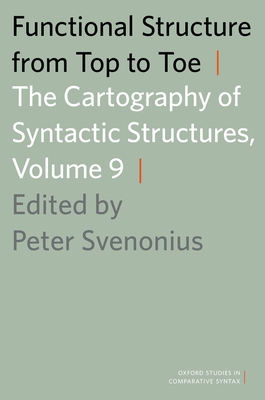
Functional Structure from Top to Toe : The Cartography of Syntactic Structures, Volume 9
Book Details
Format
Paperback / softback
Book Series
Oxford Studies in Comparative Syntax
ISBN-10
0199740380
ISBN-13
9780199740383
Publisher
Oxford University Press Inc
Imprint
Oxford University Press Inc
Country of Manufacture
GB
Country of Publication
GB
Publication Date
Oct 30th, 2014
Print length
336 Pages
Weight
448 grams
Dimensions
15.80 x 23.50 x 2.40 cms
Product Classification:
Semantics, discourse analysis, etcGrammar, syntax & morphology
KSh 10,150.00
Currently unavailable
0 in stock
Delivery Location
Delivery fee: Select location
Secure
Quality
Fast
This volume consists of nine original chapters on central issues in theoretical syntax, all written by distinguished authors who have made major contributions to generative syntax, plus an introductory chapter by the editor. The collection reflects the diverse energies that have pushed the cartographic program forward over the last decade.
This volume consists of nine original chapters on central issues in theoretical syntax, all written by distinguished authors who have made major contributions to generative syntax, plus an introductory chapter by the editor. Dedicated to Tarald Taraldsen, the collection reflects the diverse energies that have pushed the cartographic program forward over the last decade. The first three papers deal with subject extraction, the que/qui alternation, and relative clause formation. Luigi Rizzi presents arguments that subjects are ''criterial'' and that subject extraction is highly restricted. Hilda Koopman and Dominique Sportiche concur, suggesting that what appears to be subject extraction in French has been misanalyzed, and involves a relative structure. Adriana Belletti shows that children avoid using object relatives, preferring subject relatives, even when it requires passivization.The fourth paper, by Ian Roberts, analyzes the loss of pro-drop in the history of French and Brazilian Portuguese. The papers by M. Rita Manzini and Richard S. Kayne both present novel analyses of complementizers, suggesting that they are essentially nominal, rather than verbal.The final three papers address the relationship of morphology to syntax. The first two argue for a syntactic approach to word formation, Guglielmo Cinque''s in a typological context and Anders Holmberg''s within an analysis of Finnish focus constructions. The final paper, by Edwin Williams, presents an argument for the limitations of the syntactic approach to word formation.
Get Functional Structure from Top to Toe by Peter ) Svenonius at the best price and quality guaranteed only at Werezi Africa's largest book ecommerce store. The book was published by Oxford University Press Inc and it has 336 pages.
Customers Who Bought This Also Bought

On Great Writing (On the Sublime)
KSh 2,000.00

Look Again: Empire
KSh 1,800.00
The Art of Rhetoric
KSh 2,000.00

The Role of the Reader
KSh 3,400.00

Six Walks in the Fictional Woods
KSh 4,850.00
The Language of Literature
KSh 3,450.00
The Sign of Three
KSh 3,250.00
The Limits of Interpretation
KSh 12,200.00

Die philippischen Reden
KSh 22,250.00

Walker Percy''s Search for Community
KSh 5,950.00
Voice of Deliverance
KSh 6,450.00

Community and Critique
KSh 10,800.00
