
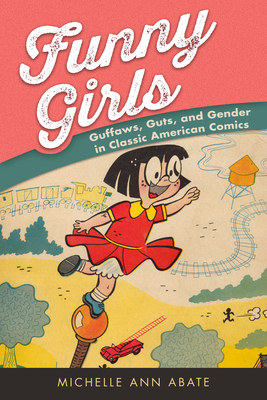
Funny Girls : Guffaws, Guts, and Gender in Classic American Comics
Book Details
Format
Hardback
ISBN-10
1496820738
ISBN-13
9781496820730
Publisher
University Press of Mississippi
Imprint
University Press of Mississippi
Country of Manufacture
US
Country of Publication
GB
Publication Date
Dec 10th, 2018
Print length
208 Pages
Weight
473 grams
Dimensions
22.80 x 15.20 x 1.60 cms
Product Classification:
Comic book & cartoon artComic book and cartoon artworkAnthologiesAnthologies (non-poetry)Literary studies: generalLiterary studies: c 1900 to c 2000Literary studies: from c 1900 -Literary companions, book reviews & guidesLiterary companions, book reviews and guidesChildren’s & teenage literature studiesChildren’s and teenage literature studies: generalPopular cultureGender studies: women and girlsPopular cultureGender studies: womenCartoons & comic stripsFunny cartoons and comic strips
KSh 15,850.00
Currently unavailable
0 in stock
Delivery Location
Delivery fee: Select location
Secure
Quality
Fast
Examines the important but long-overlooked cadre of young female protagonists in US comics during the first half of the twentieth century. Michelle Ann Abate treats characters ranging from Little Orphan Annie and Nancy to Little Lulu and Li'l Tomboy - a group that collectively forms a tradition of funny girls in American comics.
For several generations, comics were regarded as a boy''s club-created by, for, and about men and boys. In the twenty-first century, however, comics have seen a rise of female creators, characters, and readers. While this sudden presence of women and girls in comics is being regarded as new and noteworthy, the observation is not true for the genre''s entire history.
Throughout the first half of the twentieth century, the medium was enjoyed equally by both sexes, and girls were the protagonists of some of the earliest, most successful, and most influential comics. In Funny Girls: Guffaws, Guts, and Gender in Classic American Comics, Michelle Ann Abate examines the important but long-overlooked cadre of young female protagonists in US comics during the first half of the twentieth century. She treats characters ranging from Little Orphan Annie and Nancy to Little Lulu, Little Audrey of the Harvey Girls, and Li''l Tomboy-a group that collectively forms a tradition of funny girls in American comics.
Abate demonstrates the massive popularity these funny girls enjoyed, revealing their unexplored narrative richness, aesthetic complexity, and critical possibility. Much of the humor in these comics arose from questioning gender roles, challenging social manners, and defying the status quo. Further, they embodied powerful points of collection about both the construction and intersection of race, class, gender, and age, as well as popular perceptions about children, representations of girlhood, and changing attitudes regarding youth. Finally, but just as importantly, these strips shed light on another major phenomenon within comics: branding, licensing, and merchandising. Collectively, these comics did far more than provide amusement-they were serious agents for cultural commentary and sociopolitical change.
Throughout the first half of the twentieth century, the medium was enjoyed equally by both sexes, and girls were the protagonists of some of the earliest, most successful, and most influential comics. In Funny Girls: Guffaws, Guts, and Gender in Classic American Comics, Michelle Ann Abate examines the important but long-overlooked cadre of young female protagonists in US comics during the first half of the twentieth century. She treats characters ranging from Little Orphan Annie and Nancy to Little Lulu, Little Audrey of the Harvey Girls, and Li''l Tomboy-a group that collectively forms a tradition of funny girls in American comics.
Abate demonstrates the massive popularity these funny girls enjoyed, revealing their unexplored narrative richness, aesthetic complexity, and critical possibility. Much of the humor in these comics arose from questioning gender roles, challenging social manners, and defying the status quo. Further, they embodied powerful points of collection about both the construction and intersection of race, class, gender, and age, as well as popular perceptions about children, representations of girlhood, and changing attitudes regarding youth. Finally, but just as importantly, these strips shed light on another major phenomenon within comics: branding, licensing, and merchandising. Collectively, these comics did far more than provide amusement-they were serious agents for cultural commentary and sociopolitical change.
Get Funny Girls by Michelle Ann Abate at the best price and quality guaranteed only at Werezi Africa's largest book ecommerce store. The book was published by University Press of Mississippi and it has 208 pages.
Customers Who Bought This Also Bought
Tokyo Ghoul Illustrations: zakki
KSh 3,600.00

Draw Manga Action
KSh 2,700.00

The Secret History of Wonder Woman
KSh 3,050.00
Philosophy of Snoopy
KSh 1,800.00
Peanuts Guide to Friendship
KSh 1,800.00
Official Peanuts
KSh 1,800.00

Art of Marvel Vol.1
KSh 3,400.00

Art of Marvel Vol.2
KSh 3,400.00
Life Lessons from Lucy
KSh 1,800.00
Official Peanuts
KSh 1,800.00

Marvel Comics Library 2
KSh 31,500.00
Bobbie Goods Sunshine Coloring & Drawing
KSh 2,000.00
More by Michelle Ann Abate

Blockheads, Beagles, and Sweet Babboos
KSh 15,850.00

Blockheads, Beagles, and Sweet Babboos
KSh 3,700.00
Over the Rainbow
KSh 7,550.00
The Big Smallness
KSh 9,900.00

Bloody Murder
KSh 8,450.00
No Kids Allowed
KSh 5,200.00
Raising Your Kids Right
KSh 5,400.00
The Big Smallness
KSh 33,850.00
No Kids Allowed
KSh 13,600.00

Over the Rainbow
KSh 17,800.00
C.S. Lewis
KSh 14,400.00

Singular Sensations
KSh 4,500.00
