
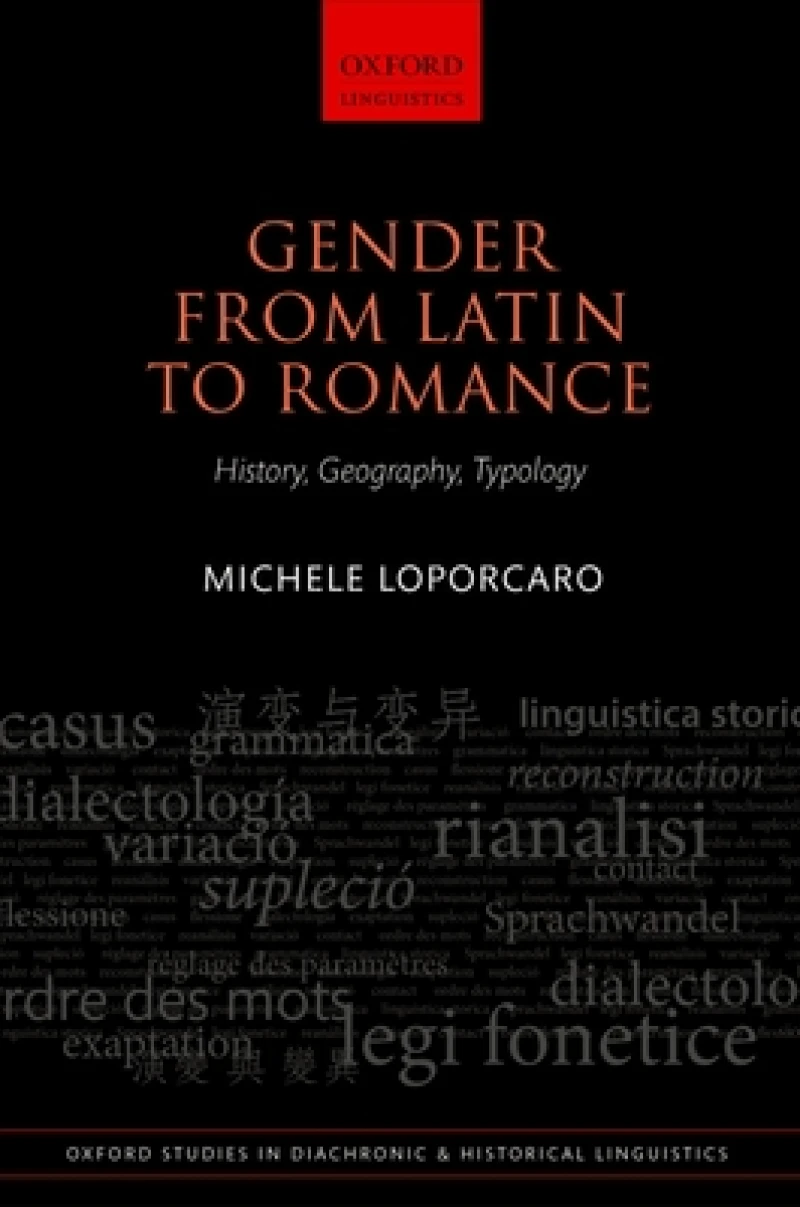
Gender from Latin to Romance : History, Geography, Typology
Book Details
Format
Hardback or Cased Book
ISBN-10
0199656541
ISBN-13
9780199656547
Publisher
Oxford University Press
Imprint
Oxford University Press
Country of Manufacture
GB
Country of Publication
GB
Publication Date
Dec 14th, 2017
Print length
414 Pages
Weight
834 grams
Dimensions
24.20 x 16.10 x 2.60 cms
Product Classification:
Historical & comparative linguisticsGrammar, syntax & morphology
Ksh 24,800.00
Manufactured on Demand
0 in stock
Delivery Location
Delivery fee: Select location
Secure
Quality
Fast
This book explores grammatical gender in the Romance languages and dialects and its evolution from Latin. It outlines the significant diversity found in the Romance varieties in this regard and uses this variation to show that traditional accounts of the loss of neuter gender cannot be correct.
This book explores grammatical gender in the Romance languages and dialects and its evolution from Latin. Michele Loporcaro investigates the significant diversity found in the Romance varieties in this regard; he draws on data from the Middle Ages to the present from all the Romance languages and dialects, discussing examples from Romanian to Portuguese and crucially also focusing on less widely-studied varieties such as Sursilvan, Neapolitan, and Asturian. The investigation first reveals that several varieties display more complex systems than the binary masculine/feminine contrast familiar from modern French or Italian. Moreover, it emerges that traditional accounts, whereby neuter gender was lost in the spoken Latin of the late Empire, cannot be correct: instead, the neuter gender underwent a range of different transformations from Late Latin onwards, which are responsible for the different systems that can be observed today across the Romance languages. The volume provides a detailed description of many of these systems, which in turns reveals a wealth of fascinating data, such as varieties where ''husbands'' are feminine and others where ''wives'' are masculine; dialects in which nouns overtly mark gender, but only in certain syntactic contexts; and one Romance variety (Asturian) in which it appears that grammatical gender has split into two concurrent systems.The volume will appeal to linguists from a range of backgrounds, including Romance linguistics, historical linguistics, typology, and morphosyntax, and is also of relevance to those working in sociology, gender studies, and psychology.
Get Gender from Latin to Romance by at the best price and quality guaranteed only at Werezi Africa's largest book ecommerce store. The book was published by Oxford University Press and it has pages.

